Intel GPU D270: 160 GB LPDDR5X, 1.5 TB/s, and Native FP64 at 350W
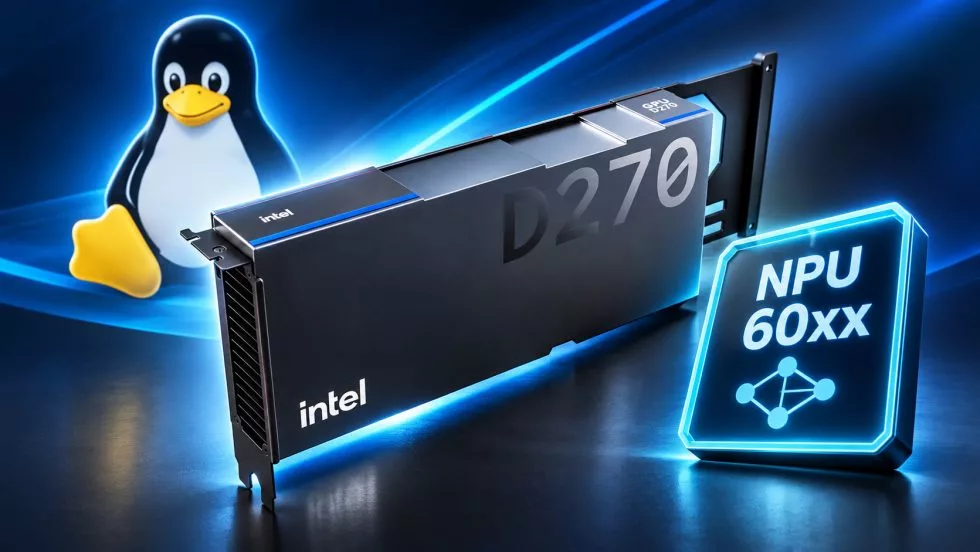
Intel has released new technical details regarding the D270 GPU, an accelerator currently under development under the codename Crescent Island. Moving away from traditional consumer or workstation targets, the D270 is designed to bridge the gap between high-performance computing (HPC) and AI inference, utilizing the Xe3P architecture to support a massive precision range from FP4 to FP64.
The D270 is built on the Xe3P architecture and features 32 Xe-Cores and 256 XMX (Xe Matrix eXtensions) units. A standout technical specification is its native FP64 support at full rate, a feature Intel is explicitly highlighting for scientific and technical HPC applications. To support these heavy workloads, the card is equipped with 160 GB of LPDDR5X memory, providing a total bandwidth of 1.5 TB/s. The design is intended for PCIe 5.0 slots with air cooling and has a power consumption of 350W.
Bridging HPC and AI Inference
Rather than targeting gaming or standard workstation tasks, Intel is positioning the D270 for data centers, scientific simulations, and AI inference. The architecture's ability to cover a wide precision spectrum is key: low-precision data types are optimized for AI inference, while native double-precision (FP64) remains essential for financial modeling, seismic imaging, and numerical simulations. While Intel has confirmed the inclusion of full-rate FP64 execution, the company has not yet disclosed the absolute FP64 performance metrics in this release.
In a notable departure from many modern AI accelerators that prioritize low-precision tensor operations, Intel's decision to include native FP64 on the same platform aims to serve two distinct markets simultaneously. Interestingly, Intel has opted for 160 GB of LPDDR5X instead of HBM (High Bandwidth Memory). While the 1.5 TB/s bandwidth is significantly lower than current high-end HBM-based accelerators, LPDDR5X offers potential advantages in terms of cost, availability, and power efficiency. Intel also noted that the memory capacity is scalable up to 480 GB when multiple D270 accelerators are used in a cluster, though this represents a distributed pool rather than a single contiguous memory space on one card.
The 350W power envelope is relatively moderate for this class of hardware. By utilizing a PCIe 5.0 air-cooled design, the D270 can be integrated into standard server chassis without requiring specialized liquid cooling infrastructure, simplifying deployment in existing data centers. However, the actual efficiency per compute operation remains to be seen; independent benchmarks will be required to determine how much FP64, FP32, or AI performance Intel can actually deliver within this power budget.
Software and Architecture Strategy
The D270 architecture maintains a dual-path approach: the 32 Xe-Cores handle traditional GPU operations, while the 256 XMX units are optimized for matrix mathematics and lower-precision workloads. To support this hardware, Intel is emphasizing an open software stack. For HPC environments, hardware capability is only half the battle; the success of the D270 will depend heavily on how effectively compilers, libraries, and existing applications can be ported to this platform and how well it integrates with established Xeon or existing GPU ecosystems.