Intel details Diamond Rapids Xeon and GPU D-series accelerators
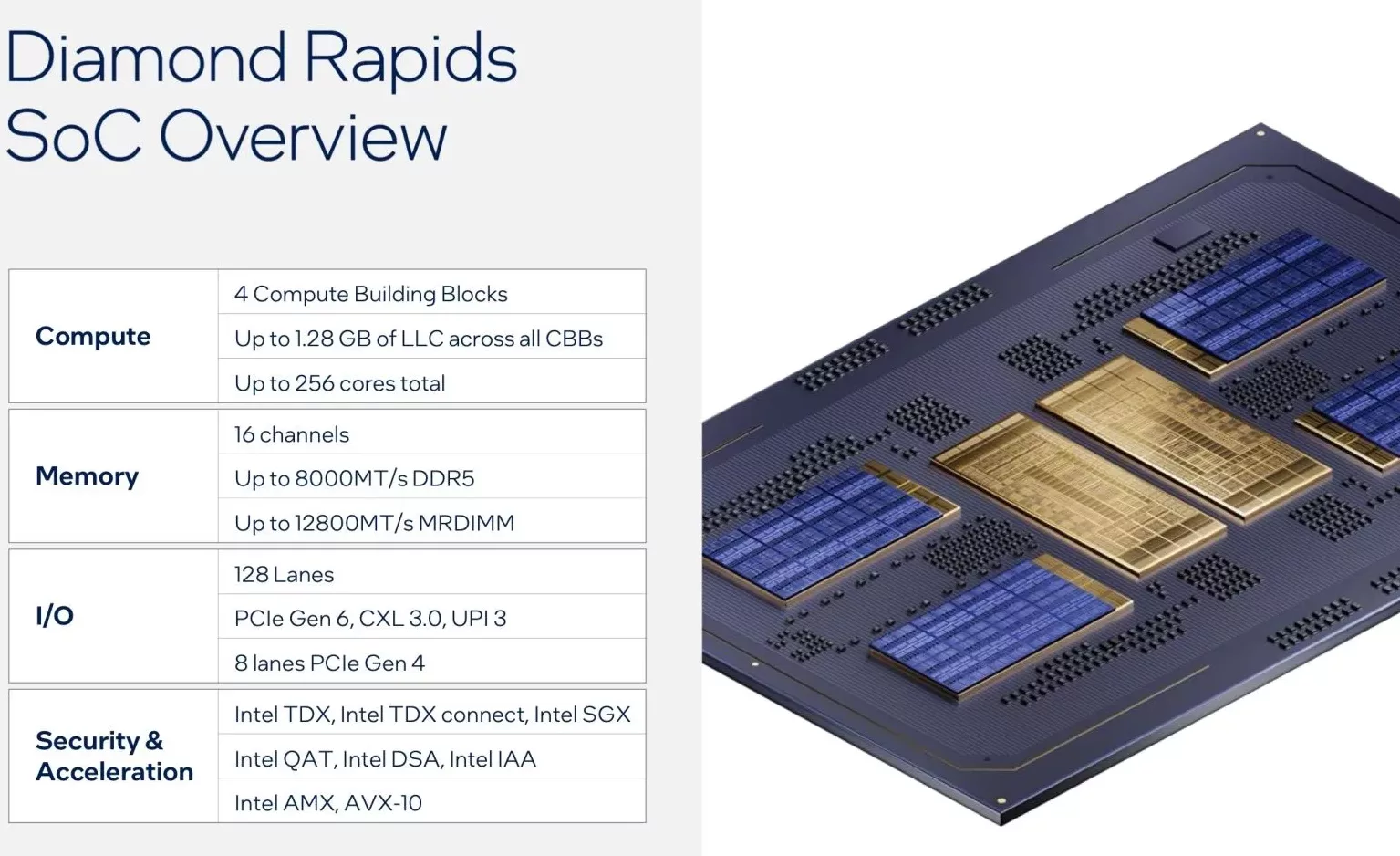
At the SC26 conference, Intel shared new details regarding its upcoming server hardware: the Diamond Rapids Xeon processors and D-series GPU accelerators. These next-generation components are specifically engineered to handle intensive AI and High-Performance Computing (HPC) workloads through increased core counts and significantly higher memory bandwidth.
The Diamond Rapids architecture is set to succeed the current Xeon 6 platform. Intel stated that these processors could feature up to 256 performance cores. Key technical enhancements include support for Advanced Performance Extensions (APX), AVX 10.2, and enhanced Advanced Matrix Extensions (AMX), which are designed to accelerate complex mathematical operations essential for AI processing.
Memory and cache specifications for Diamond Rapids show a substantial leap, with a reported memory bandwidth of up to 1.6 TB/s and a last-level cache (L3) capacity reaching as much as 1.28 GB. Such improvements aim to address the data-intensive nature of modern enterprise computing.
GPU D-series for AI and Scientific Computing
Alongside the CPUs, Intel introduced the D-series GPU accelerators, targeting AI inference and scientific research. These accelerators will support a wide range of data formats, from FP4 and MXFP4 up to FP64. Notably, top-tier configurations are expected to feature up to 480 GB of LPDDR5X memory while maintaining a standard PCIe form factor and an air-cooled design for easier deployment.
On the software front, Intel is emphasizing compatibility with existing ecosystems. The company reaffirmed its commitment to oneAPI, Intel MPI, Fortran, and its broader compiler toolchain, aiming to integrate AI workloads into established HPC environments without requiring developers to rewrite their existing codebases.