

Hell Let Loose: Vietnam review — Big Walk with guns?

Hell Let Loose: Vietnam arrives as a demanding, communication-heavy war simulator that transplants the rigid command structure of its predecessor into the dense jungles of Southeast Asia. Developed by Expression Games and published by Team17, this title takes the core DNA of the original Hell Let Loose—where squads of six operate under a strict hierarchy—and expands it to 100-player battles across massive maps. While the game offers an immersive, atmospheric experience with unique faction asymmetries between US forces and North Vietnamese troops, its success is entirely dependent on vocal teamwork. Without constant coordination, the intense jungle environments can easily turn into frustrating snipe-fests where players are repeatedly eliminated without clear feedback. The review explores whether this punishing but rewarding simulation justifies the steep learning curve required to master its chaotic battlefield.
A Harsh Introduction to Jungle Warfare
The most striking aspect of Hell Let Loose: Vietnam is how it forces players into a role that demands constant vocal engagement. Unlike its predecessor, which offered a more gentle onboarding experience, this title operates on a "stick" philosophy rather than a "carrot" one. The game does not shy away from punishing players who fail to communicate or adhere to the rules of engagement. If you do not coordinate with your squadmates, you will be overwhelmed and eliminated quickly.
This intensity is amplified by the setting itself. Moving from the hedgerows of 1940s Normandy to the lush vegetation of Southeast Asia changes the fundamental nature of combat. The maps are significantly larger than typical shooters like Battlefield, featuring dense forests, rice paddies, and industrial zones that offer both cover and exposure. However, this environment comes with a steep price: visibility is severely compromised.
Players often find themselves crawling through long grass, relying entirely on the sound of enemy weapons to locate threats. The game does not explicitly register kills for the player unless they are close enough to hear a victim collapse or see them fall. This lack of immediate visual confirmation can lead to confusion and frustration, as players may be unaware of their own deaths until they respawn.
Faction Asymmetry and Command Structure
One of the key features distinguishing Hell Let Loose: Vietnam from other shooters is its implementation of faction asymmetry. The two opposing forces, the US Army and the North Vietnamese Army (NVA), possess distinct capabilities that reflect their historical counterparts. The US side has access to helicopters for troop transport and air support, while the NVA can construct a network of underground tunnels for fast travel and stealth operations.
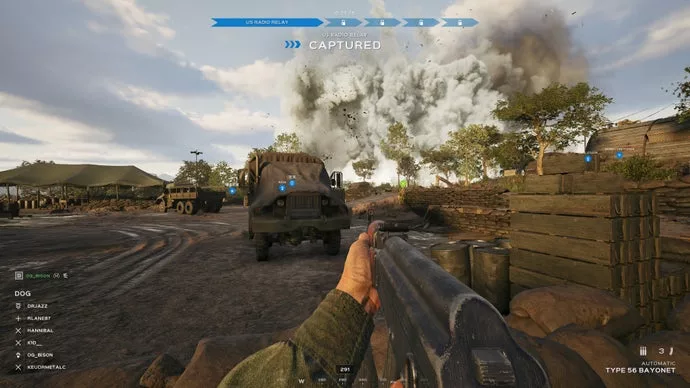
Beyond faction differences, the game maintains a rigid command hierarchy that is central to its gameplay loop. Squads of six players are overseen by squad leaders who can place spawn points to quickly reinsert fallen teammates into the fight. At a higher level, Commanders direct the overall army, managing resources and calling in airstrikes or supply drops. This structure requires a clear chain of command and effective communication at every level, from the individual soldier to the strategic commander.
The maps themselves are designed to support this large-scale warfare. Locations like Thanh Hóa Bridge feature long sightlines along riverbanks combined with close-quarters combat on the bridge itself, creating dynamic scenarios that test both range and precision. Other areas, such as Huế Outskirts, utilize elevation changes in mountainous terrain to create vertical combat opportunities.
The Double-Edged Sword of Communication
Communication is the lifeblood of Hell Let Loose: Vietnam. When players are coordinating effectively, the game delivers an utterly captivating experience. A well-oiled squad can hold off overwhelming enemy forces, call in devastating airstrikes with pinpoint accuracy, and execute complex maneuvers that would be impossible in a standard shooter. The atmosphere is palpable, with napalm strikes erupting across treelines and helicopters buzzing overhead.
However, the game's reliance on voice chat also exposes it to the darker side of online multiplayer gaming. Players are inevitably exposed to toxic behavior, including racism and harassment. While the game provides tools to mute and block individuals, the design mandates engagement with other players as part of its core loop. This means that a poor community experience can significantly detract from the enjoyment of the simulation.
Furthermore, the lack of traditional hit markers forces players to rely on audio cues and visual confirmation to determine if they have successfully eliminated an enemy. While this adds to the realism, it can also lead to disputes and confusion, especially in the dense jungle where sound carries differently than in open environments.
Technical Limitations and Gameplay Challenges
From a pure shooter perspective, Hell Let Loose: Vietnam faces some significant challenges. Movement is described as clumsy and sluggish, which can hinder the fast-paced action expected in modern shooters. When players do get close enough to engage an enemy directly, the interaction feels oddly intangible, lacking the crisp feedback found in competitors.
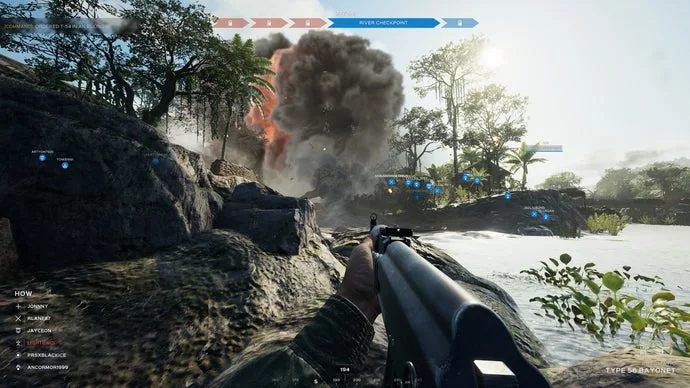
The game also struggles with issues related to level-of-detail (LOD) phasing. In some instances, a player may appear more visible than they should be at a distance due to rendering limitations, making them an easy target for snipers. This can lead to frustrating situations where players are repeatedly headshot without understanding the source of the threat.
Additionally, the game's approach to accessibility is limited. There is no dedicated accessibility options submenu, though various toggles are available in other menus, such as camera motion, lean, ADS, sprint, and steady aim. These options allow for some customization but do not go as far as a comprehensive accessibility suite might.
Conclusion: A High-Reward Simulation
Hell Let Loose: Vietnam encapsulates the best and worst of online multiplayer gaming. When the pieces click into place, it offers battlefields that are more interesting and strategically deep than many mainstream titles. The combination of large maps, unique faction abilities, and a strict command structure creates a simulation that feels authentic and engaging.
However, the game is not consistently entertaining for everyone. It requires a significant investment of time and effort to learn its mechanics, master the movement, and build a cohesive team. Players must be willing to tolerate a certain level of chaos and toxicity to reap the rewards of a well-coordinated squad. Ultimately, Hell Let Loose: Vietnam is a fascinating war simulator that works best when it comes together, but it demands a high level of commitment from its players.
Available now on PC (Steam, Epic), PS5, and Xbox Series X/S, the game stands as a bold attempt to push the boundaries of the shooter genre, even if it does so with a heavy dose of difficulty and frustration. For those willing to embrace the challenge, Hell Let Loose: Vietnam offers an experience that is unlike anything else in the current market.
Флешка
