
GeForce RTX 5070 Ti Undervolting: 143W Power Draw with Reduced Clocks
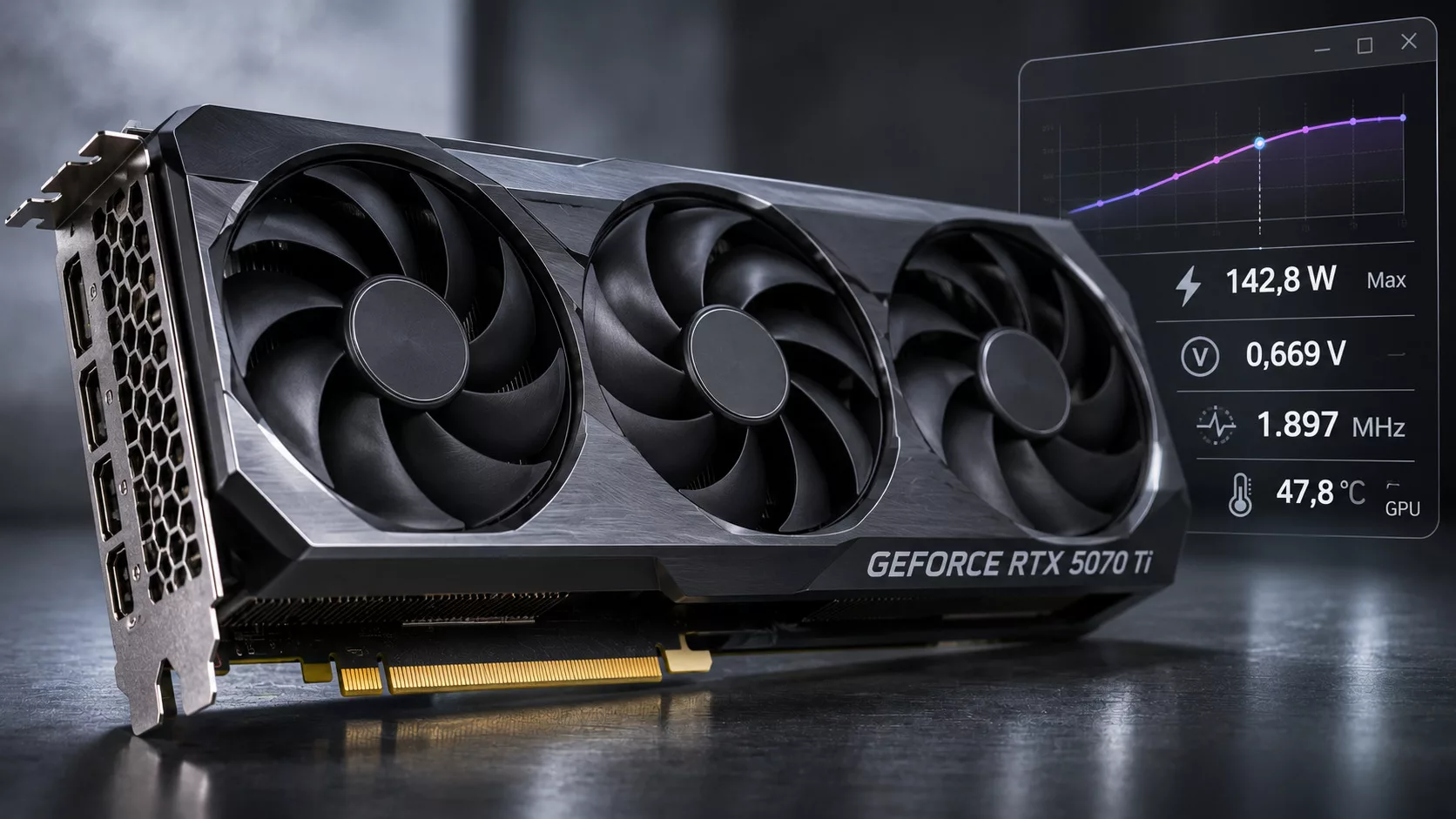
A Reddit user has demonstrated the potential for extreme undervolting on the GeForce RTX 5070 Ti, cutting power consumption nearly in half. However, without performance benchmarks or stability data, the actual efficiency gains remain speculative.
Using the mVolt+ utility (version 0.47.2), the user managed to limit the maximum board power to 142.8W. Under this profile, the GPU operated at approximately 1.897 GHz with a voltage of 0.669V. The setup utilized a -145 mV voltage offset combined with a +300 MHz clock offset, while the memory frequencies remained at stock settings.
Power Savings vs. Clock Speed
While a 143W draw is a striking reduction from the official 300W TGP, the context is crucial. The GPU clock of under 1.9 GHz is significantly lower than the standard operating frequencies for an RTX 5070 Ti during gaming. Without corresponding frame rate data or standardized benchmarks, it is impossible to determine how much performance is being sacrificed to achieve these lower power numbers.
Reliability and measurement consistency also remain unverified. The provided screenshots do not prove that the 0.669V voltage is maintained consistently under full load, nor do they show results from extended stability testing. GPU stability is not binary; a card might pass a short benchmark but crash during P-State transitions or in specific gaming scenarios.
Blackwell Architecture Insights
Technically, the experiment highlights the flexibility of the Blackwell architecture. The GB203 chip used in the RTX 5070 Ti is also found in mobile configurations with much tighter power envelopes. While it is not surprising that the chip can operate well below 300W, the real metric for efficiency is how much performance is retained within that lower power window.
To achieve these results, mVolt+ utilizes experimental BIOS-override capabilities available in NVIDIA drivers starting from version 621.01. It is worth noting that such advanced methods are not strictly necessary for standard undervolting, as voltage-frequency curves and clock offsets can still be adjusted through conventional means.
Гика
