

Enthusiast turns a Lenovo Yoga laptop, an M.2 slot, and AMD Radeon RX 7900 XT into 'the world's stupidest' desktop for local AI chatbots — M.2 franken-rig crippled by laptop DRAM swap
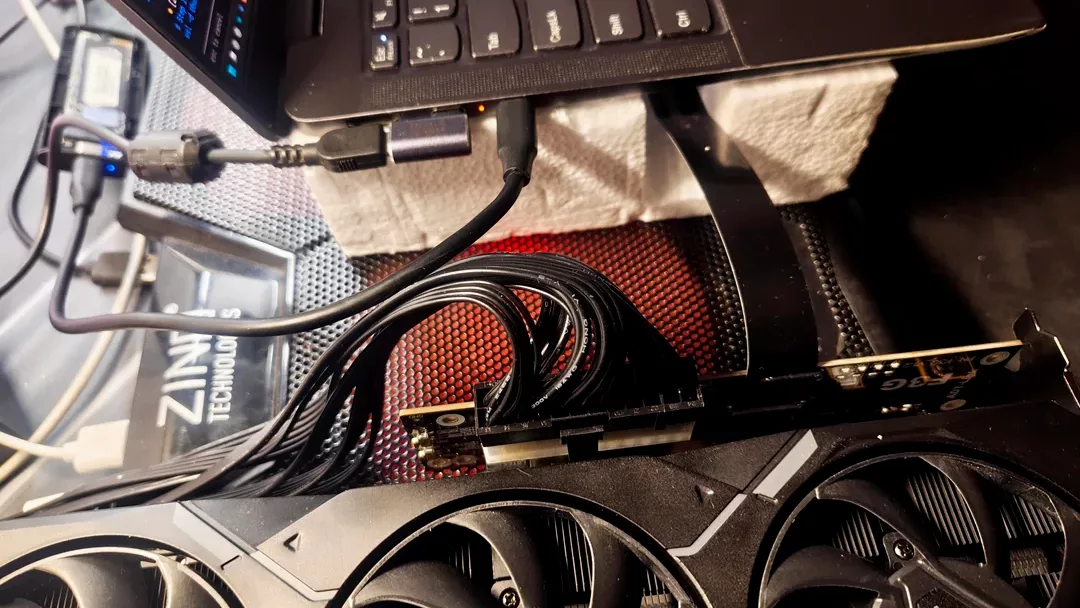
An enthusiast from India has constructed a unique workstation by combining a Lenovo Yoga laptop chassis with an external PCIe adapter and an AMD Radeon RX 7900 XT, aiming to run local large language models. However, the unconventional build quickly revealed a critical hardware limitation: the swap of the laptop's internal memory for the graphics card rendered the system unusable for its intended purpose.
The project began when Redditor Alternative-Panic69, known online as Panic, sought to run large language models (LLMs) such as Qwen and GLM on a budget. Finding an AMD Radeon RX 7900 XT with 20 GB of VRAM for $550 in India, he viewed it as an excellent deal. His initial plan was to install the card into a Lenovo M910Q desktop tower, but the machine refused to cooperate with the new graphics hardware.
Faced with this obstacle, Panic pivoted to a more unconventional solution: converting his own Lenovo Yoga laptop into a desktop development board. He performed what he described as "surgery" on the device, using an ADT-Link PCIe external cable connector plugged directly into the laptop's M.2 slot. To power this setup, he utilized a DeepCool PL750D power supply unit and removed the bottom panel of the chassis to accommodate the necessary wiring.
The initial configuration faced immediate challenges regarding booting and display output. Panic managed to get the system to boot using a USB SSD as the primary drive. The main display connected directly to the AMD Radeon RX 7900 XT performed well, with stress tests like Furmark reaching 500 FPS at 1080p resolution. However, this arrangement was unsustainable because the graphics card's framebuffer consumed valuable video memory that the LLMs desperately needed.To resolve the display issue, Panic reverted the integrated graphics silicon to its original assignment of driving the screen. This decision highlighted a fundamental conflict in the build: the system could not simultaneously utilize the GPU for heavy AI computation and the iGPU for basic display output without sacrificing performance or memory resources. The laptop chassis effectively became a development board with limited utility.
The true bottleneck emerged when Panic attempted to run larger models, specifically Qwen 35B A3B and GLM-4.7 Flash, utilizing a massive 128K-token context window. Another Redditor correctly identified the situation as a classic "pick two out of three" dilemma involving the GPU, the CPU, and system memory. Panic discovered that his laptop's internal DRAM was insufficient to hold the large context windows required by these models.
As the available RAM filled up, the system began relying on swap space, which severely degraded performance. The GPU would frequently sit idle, only activating in brief bursts when data could be swapped from disk to memory. This grinding halt in performance made the build impractical for serious local AI work. The enthusiast realized that while the project was visually striking and technically interesting, the lack of sufficient system memory crippled the rig's ability to function as a viable AI workstation.
Ultimately, Panic decided to abandon the Lenovo Yoga conversion project to restore his laptop's mobility. He opted to purchase an old office tower running on the AM4 platform, which could physically accommodate both the AMD Radeon RX 7900 XT and the external power supply. As Panic admitted, buying a standard desktop would have been the sensible solution, but he was not interested in being sensible. The experiment served as a cautionary tale about the specific memory requirements of modern AI workloads and the limitations of repurposing laptop components for high-performance computing tasks.
Гика
