Doom runs on a USB stick's built-in screen
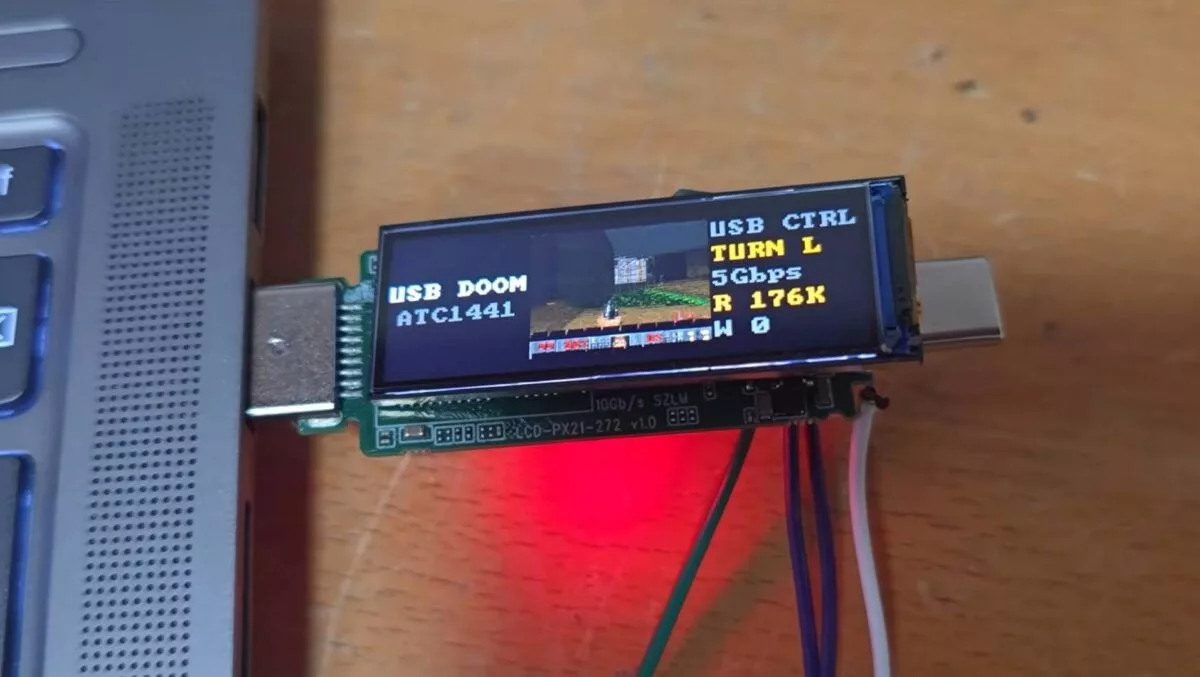
Doom has found yet another unconventional platform. Following its appearance on pregnancy testers and DSLR cameras, the game is now running on the built-in color display of a USB flash drive, a screen originally intended for displaying device metrics.
Modder Aaron Christophel has managed to get Doom running on a $48 MOVESPEED MSSU10 128GB USB drive. The setup allows the game to run entirely within the drive's internal hardware: the controller handles the game logic, while the built-in 428×142 pixel screen serves as the monitor. While this display is typically used to show storage capacity, temperature, or transfer speeds, it now renders game graphics.
To achieve this, Christophel had to modify the firmware of the drive's secondary C*Core CCM4101 microcontroller, which features 2MB of flash and 128KB of SRAM. Due to the severe hardware constraints, the mod relies on Artur Bieniek’s DMC100-DOOM project, a version of the engine optimized for low-performance hardware. The result is a playable 13 fps, with the in-game logic operating at the standard 35 ticks per second. However, due to space limitations, only the first level, E1M1, fits on the drive.
Since the USB drive lacks physical buttons for input, Christophel implemented a creative control scheme using data read and write operations. A script transforms keyboard presses into timed data transfers: for instance, reading data moves the character forward, while writing moves them backward. Despite this unconventional method, the input latency is approximately 100ms, which is considered serviceable for this type of setup.