

DLSS on Radeon: d4r mod brings official NVIDIA upscaling to Navi 32 GPUs

A developer known as countervolts has unveiled d4r (short for DLSS 4 Radeon), a project that enables NVIDIA's official DLSS Super Resolution libraries to run on AMD RDNA3 GPUs. The solution operates under Linux and Proton, utilizing the ZLUDA compatibility layer to translate CUDA calls for AMDGPU hardware via ROCm/HIP.
How it works: Translation via ZLUDA
The d4r project is not a full-scale emulation of the entire graphics subsystem but rather a complex translation chain. The process begins with the game (D3D12), which uses OptiScaler to pass DLSS inputs to a modified d4r_nvngx.dll. Instead of executing NVIDIA's code directly, CUDA calls are redirected through a Wine bridge to ZLUDA, which translates PTX instructions into native AMDGPU code.
To ensure stability, the developer had to replace the most demanding DLSS 4 and 4.5 kernels with custom RDNA3 versions. Without these overrides, the Navi 32 architecture produced invalid output when running through ZLUDA alone, causing the DLSS system to discard the neural network results entirely.
Architecture Support and Performance
The current release is specifically optimized for Navi 32 chips, which include the Radeon RX 7700 XT, RX 7800 XT, RX 7700, and Radeon PRO W7700. While Navi 31 and Navi 33 cards can run DLSS 3 at full speed, support for newer versions is limited: DLSS 4 currently operates without its transformer, and DLSS 4.5 runs at roughly half speed because native kernels for those specific GPUs have not yet been included.
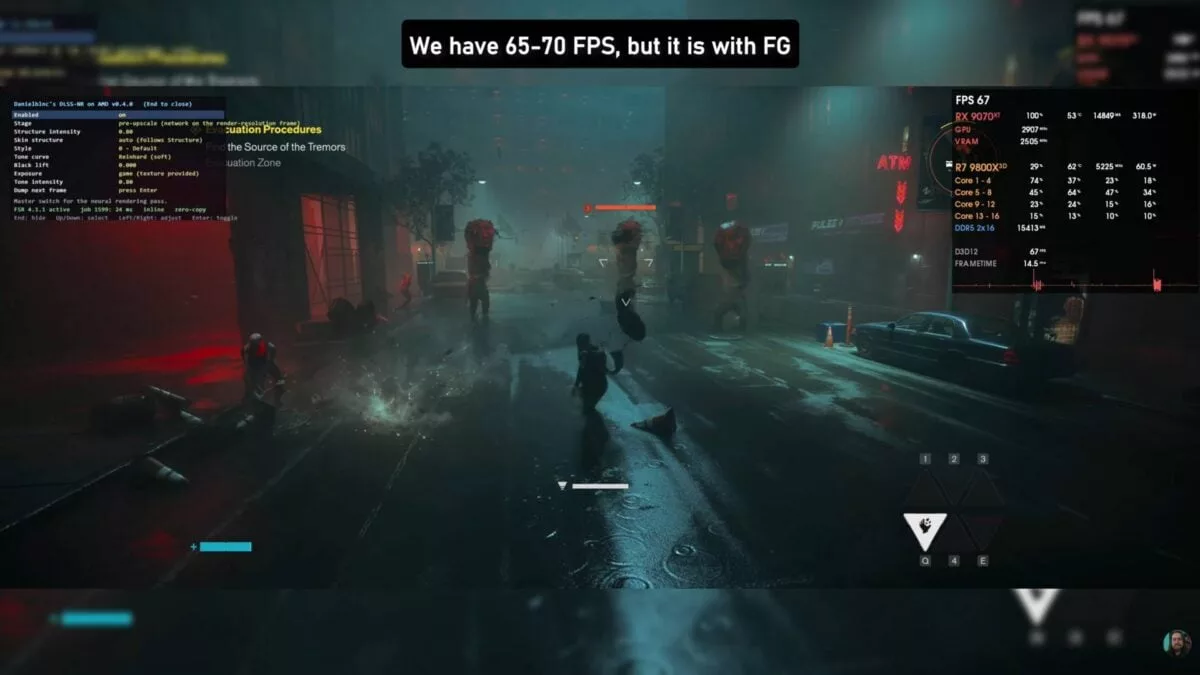
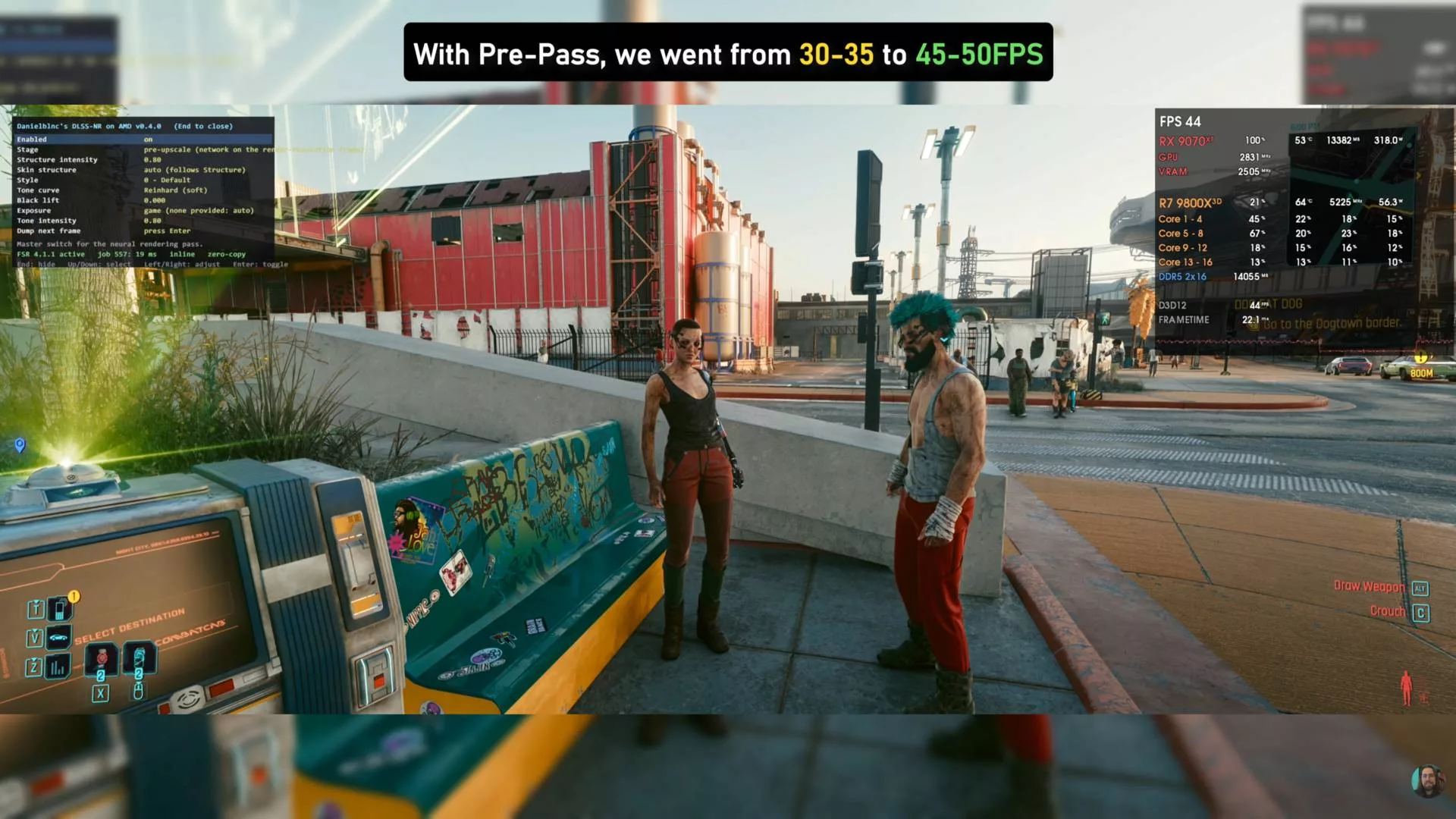
In benchmarks conducted on SILENT HILL Townfall (2560×1440) using an RX 7700 XT, the following results were observed:
- DLSS 3 CNN (Preset E): 72.4 FPS (the fastest option for Quality, Balanced, and Performance settings);
- DLSS 4 K: 69.4 FPS;
- DLSS 4.5 M: 51.5 FPS.
Interestingly, DLSS 4 becomes the faster option in Ultra Performance mode, reaching 94.5 FPS compared to 88.9 FPS with DLSS 3. However, AMD's own FSR 4 remains faster in every tested mode. Currently, the project is an experimental Linux and Proton-only endeavor and does not support DLSS 5.
Гика
