
DLSS Frame Generation: New Preset Delivers Up to 36% More FPS
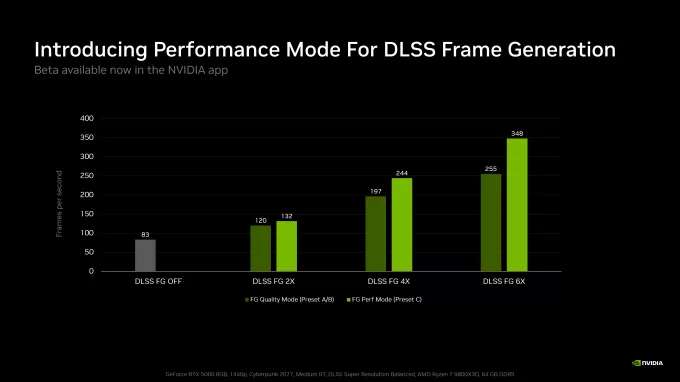
NVIDIA has introduced an additional performance mode for DLSS Frame Generation within the new beta version of the NVIDIA App. Known as Preset C, this mode aims to accelerate the calculation of AI-generated intermediate frames. According to NVIDIA, users can see performance improvements of up to 35%, though this comes with a trade-off in image quality.
Technical Implementation of Preset C
Currently, DLSS Frame Generation and Multi Frame Generation rely on two distinct AI models. The first utilizes engine data, such as motion vectors and depth information, to track object movement between rendered frames. The second model calculates optical flow, capturing details that motion vectors might miss, such as user interfaces or specific ray tracing effects.
With Preset C, NVIDIA replaces this second, more computationally intensive model with a faster, less demanding algorithm. The saved computational resources are then used to speed up the overall frame generation process.
Benchmark Results: The Multi-Frame Advantage
The performance gains from Preset C become more pronounced as the number of generated frames increases. NVIDIA shared benchmarks from Cyberpunk 2077 using a GeForce RTX 5060 (8 GB), an AMD Ryzen 7 9800X3D, and 64 GB of "DDR5" RAM. The test was conducted at 2560 × 1440 resolution with medium ray tracing settings and DLSS Super Resolution set to Balanced.
- Standard Frame Generation (2x): FPS increased from 120 to 132, a 10% improvement.
- Multi Frame Generation (4x): FPS rose from 197 to 244, a roughly 24% increase.
- Multi Frame Generation (6x): FPS jumped from 255 to 348, representing a 36.5% boost.
The data suggests that the efficiency of the new algorithm is most beneficial in high-multiplier scenarios, where the reduction in computational overhead significantly impacts the final frame rate.
Considerations and Availability
It is important to note that Preset C increases the output frame rate, not the underlying game rendering performance. Consequently, the improvement in frame rate does not necessarily translate to a proportional reduction in input latency. Furthermore, NVIDIA has not yet detailed the extent of potential visual degradation, particularly regarding complex motion or ray-traced effects.
The new mode is currently exclusive to the NVIDIA App beta. To access it, users must enable participation in beta and experimental features in the app settings. Once enabled, Preset C can be selected under DLSS Override – Model Presets, either globally or for specific titles. Support extends to the GeForce RTX 40 and RTX 50 series, as well as laptops equipped with RTX Spark.
Гика
