

The Only 14-inch Laptop with Nvidia RTX Spark: Asus ProArt P14 Review
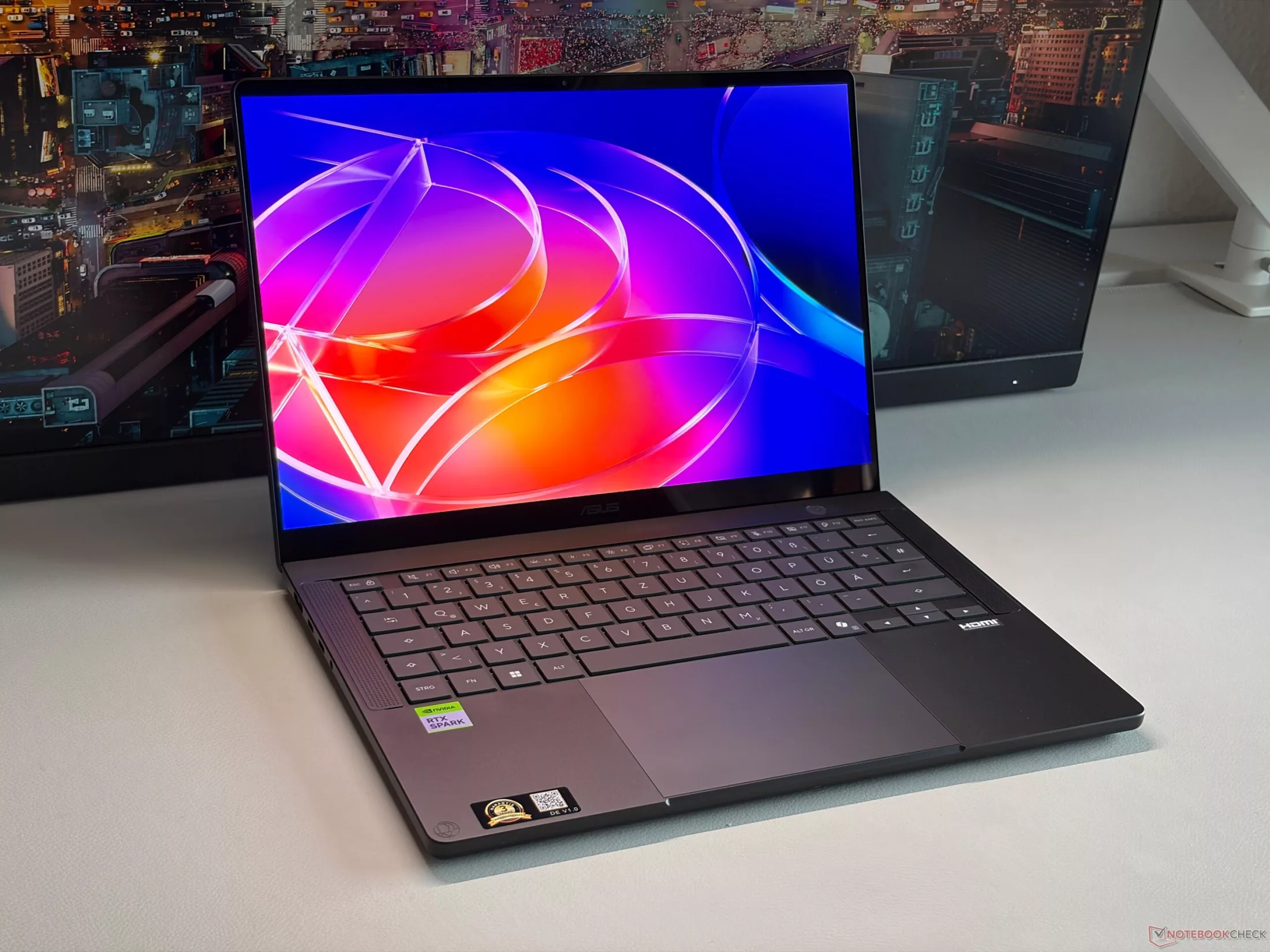
The Asus ProArt P14 enters a unique niche as the only 14-inch laptop currently powered by Nvidia's new RTX Spark N1X SoC. While it offers a premium build, an exceptional tandem OLED display, and impressive battery-to-performance stability, it is not without significant trade-offs. For professionals looking to run large AI models locally, the current 32 GB RAM limitation and the premium price tag may complicate the value proposition.
The ProArt P14 is built around the high-tier version of the Nvidia RTX Spark N1X SoC, featuring 20 CPU cores and 6144 GPU cores based on the Blackwell architecture. In our testing, the performance was consistently decent, though it sits slightly below the 16-inch models we have reviewed previously. One notable advantage is its power efficiency: the device maintains nearly identical performance levels whether it is plugged into a wall outlet or running on battery power.
Design, Display, and Connectivity
Asus has opted for a sleek metal chassis that feels exceptionally sturdy and well-built. It is more compact than the MacBook Pro 14 Mini-LED and more streamlined than the ROG Zephyrus G14. While the build quality is excellent, the black finish is a magnet for fingerprints and requires frequent cleaning. The keyboard is highly comfortable for long typing sessions, and the haptic touchpad performs reliably, though the physical dial found on previous ProArt models has been removed.
The standout feature is the 14-inch 2.8K tandem OLED touchscreen from Samsung, featuring a 120 Hz refresh rate. We measured impressive brightness levels: approximately 700 nits for SDR content and peaking at nearly 1700 nits for HDR. While the color accuracy is superb for professional editing (covering 99.9% of sRGB and Display P3), the touchscreen layer introduces a visible grid pattern, particularly noticeable when viewing bright content. Additionally, while the device offers Wi-Fi 7 and a full-size SD-card reader, it lacks SD Express support, a feature reserved for the larger ProArt P16.
Performance and the RAM Bottleneck
Under the hood, the RTX Spark N1X Blackwell GPU provides raw performance that sits between a mobile GeForce RTX 5060 and an RTX 5070. While it outperforms many integrated solutions, it cannot match the performance of Apple's M5 Max GPU. For gaming, the experience is capable, supporting features like DLSS 5 and frame generation, though users should be aware of current compatibility issues with certain titles like Battlefield, Call of Duty, and F1 2025 due to the ARM-based Windows environment.
The most significant drawback for the target audience—AI developers and creators—is the memory configuration. The ProArt P14 is currently limited to a maximum of 32 GB of soldered LPDDR5x-9400 RAM. Because the system allocates 16 GB of this to the GPU by default, only 16 GB remains for the OS and applications. For users intending to run large-scale local AI models, this capacity may prove insufficient, especially given the device's premium $3,719 starting price for the 32 GB SKU.
Technical Specifications
Acoustics and Thermal Performance
The Asus ProArt P14 features a dual-fan cooling solution that keeps the device silent during idle tasks and relatively quiet under light workloads, even when set to Performance mode. However, the acoustic profile becomes less consistent under heavy stress. During gaming and intensive stress tests, the fan noise fluctuates between 51.1 and 54.9 dB(A) due to a non-ideal fan curve in the Performance profile. On the positive side, no electronic coil whine was detected during testing.
Thermally, the laptop performed better than expected. Despite the high power requirements, the chassis remains surprisingly cool to the touch; the bottom surface measured a maximum of 42.7 °C, making it comfortable for lap use. The palmrest and touchpad areas remained below skin temperature, peaking at 27.4 °C. While the internal temperatures are well-managed, the 140W external power supply can get quite hot, reaching up to 55.2 °C. The high fan noise levels during peak loads might be mitigated in future software or BIOS updates.
Audio Quality: A Class Leader
The audio system, located via speaker grilles next to the keyboard, is a standout feature. The ProArt P14 delivers excellent sound quality that rivals top-tier multimedia laptops like the Apple MacBook Pro 14 (M5 Max) and the Asus ROG Zephyrus G14. The speakers are capable of reaching high volumes (87.5 dB) and provide a very linear frequency response across the mids and highs. The bass performance is also strong, staying within 4.9% of the median for its class, making it one of the best-sounding 14-inch laptops tested.
Power Consumption and Battery Life
While the 140W power supply is sufficient for the workload, the battery life is a significant drawback. Despite having a large 90 Wh battery—which offers more capacity than most of its competitors—the ProArt P14 falls short in endurance tests. In a Wi-Fi web surfing test at 150 nits, the device lasted 12 hours. This is notably less than the Asus ROG Zephyrus G14 and the Apple MacBook Pro 14, which both managed approximately 3 additional hours of runtime.
Гика
