Apex Neural Rendering: A New AI Challenger to DLSS and FSR?
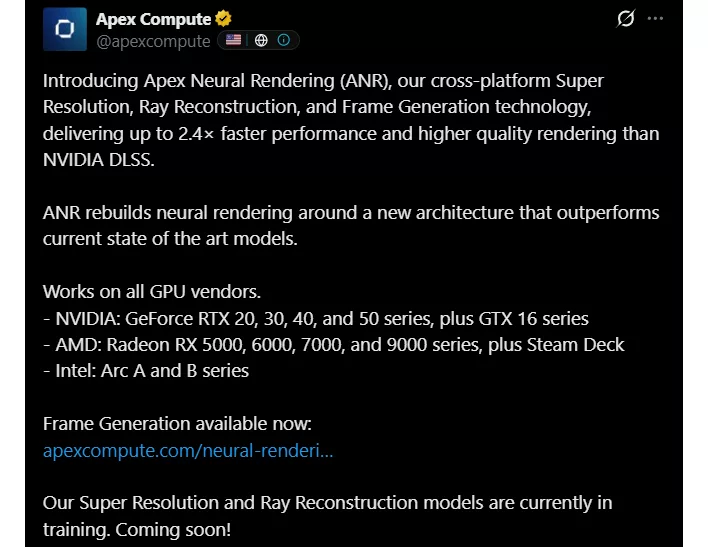
A new player has entered the AI upscaling and frame generation arena. Apex Compute, a California-based startup founded in 2024 by industry veterans from Intel and Tesla, has announced Apex Neural Rendering (ANR). This technology aims to compete directly with industry giants like NVIDIA's DLSS, AMD's FSR, and Intel's XeSS by offering a universal alternative that works across a vast range of hardware.
ANR is designed as a three-part solution, mirroring the core features of current industry standards: Super Resolution for upscaling, Frame Generation for increased smoothness, and Ray Reconstruction for enhanced ray tracing quality. While the company has already released a beta preview of its frame generation technology, development for its super resolution and ray reconstruction methods is still ongoing.
Universal Compatibility vs. Closed Ecosystems
The primary selling point of ANR is its broad hardware support, positioning it against the more restrictive requirements of NVIDIA's ecosystem. While DLSS Frame Generation requires an NVIDIA GeForce RTX 40 series or newer (and Multi Frame Generation specifically targets the RTX 50 series), ANR claims compatibility with much older and more diverse hardware. This includes NVIDIA GeForce GTX 16, RTX 20, 30, 40, and 50 series, AMD Radeon RX 5000 series and newer, Intel Arc (A- and B-series), Steam Deck, and Apple Silicon (M1 and newer).
Technically, the frame generation component relies on a highly compact neural network model, weighing only 0.17 MB. Apex Compute emphasizes that the solution is designed for cross-platform implementation, capable of running on GPUs without dedicated AI accelerators, though it can leverage existing matrix units for acceleration. This includes support for Intel Arc B-series XMX blocks and similar matrix functions in newer AMD Radeon GPUs.
Performance Claims vs. Real-World Testing
Apex Compute has made bold claims regarding efficiency. According to the company, when tested on a GeForce RTX 5090 at 3840 × 2160 resolution in 2x mode, ANR's frame generation time is 1.01 ms, compared to 1.26 ms for DLSS. In 4x mode, it reportedly drops to 0.61 ms (versus 0.82 ms for DLSS). Additionally, the startup claims ANR is significantly more memory-efficient, requiring 214 MB of VRAM compared to 562 MB for DLSS.
However, recent independent testing has cast doubt on these claims of superiority. While the technology does work on modern hardware, such as the GeForce RTX 50 series, it currently requires the Optiscaler mod to function, as it is not yet natively implemented in games. Testing revealed that the current beta version primarily supports games already running DLSSG, meaning the game must have a DLSS Frame Generation option available. During testing, the technology failed to work on AMD Radeon (RDNA 2 and 3) or Intel Arc (B-series) GPUs through the mod.
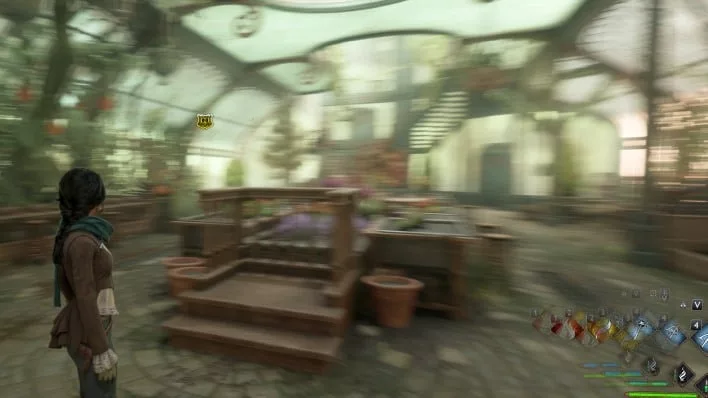
Furthermore, real-world performance results contradict Apex's marketing. In a test using Hogwarts Legacy (Greenhouse scene), an RTX 50 series card achieved an average of 186.6 FPS with ANR's 2x frame generation. Switching to DLSS FG resulted in an average of 201 FPS. This means DLSS FG was approximately 7% faster in this scenario, directly reversing Apex's claim that ANR is a faster solution. Additionally, visual artifacts were observed in Hogwarts Legacy when motion blur was enabled—an issue that required disabling motion blur to resolve—whereas DLSS FG remained stable regardless of the motion blur setting.
While the technical claims made by Apex regarding their new neural rendering technology suggest a leap beyond current industry standards, real-world testing provides a more nuanced perspective. In preliminary observations within Hogwarts Legacy, the technology demonstrated smooth motion and a lack of obvious visual artifacts. However, when compared to NVIDIA's DLSS Frame Generation (FG), the visual results appear remarkably similar in motion, making it difficult to distinguish a clear winner in practical gameplay scenarios.
The Comparison Gap: ANR vs. DLSS FG
A critical factor in evaluating these technologies is the specific configuration used for comparison. While Apex has released demonstration videos comparing their ANR FG against DLSS FG, there is a possibility that these comparisons are made against earlier versions of NVIDIA's technology. In side-by-side observations, NVIDIA's DLSS FG—specifically when using the more demanding Preset B—remains a high benchmark. While ANR FG is functional and shows real-world viability, it has not yet definitively met the high-performance claims suggested by the company during initial testing.
The Path Toward Vendor-Agnostic Solutions
The current landscape of upscaling and frame generation remains heavily fragmented by vendor-specific ecosystems. The emergence of a vendor-agnostic, ML-powered solution like Apex's could potentially resolve the current reliance on third-party workarounds like Optiscaler. For such a technology to achieve widespread adoption, the industry may need a more unified approach, potentially involving Microsoft's DirectSR, or the release of a complete, standalone solution from Apex that includes both upscaling and ray reconstruction capabilities.