AMD's New Vulkan Trick Could Slash Ray Tracing VRAM Usage by 92%
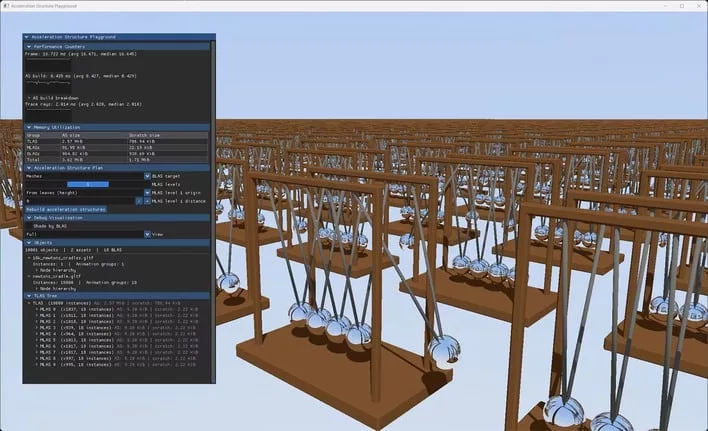
AMD has introduced an experimental ray tracing extension aimed at solving one of the most persistent bottlenecks in real-time rendering: the memory overhead of complex, dynamic scenes. Unveiled via the GPUOpen portal, the new technique, dubbed "RT-MLAS" (Ray Tracing Multi-Level Acceleration Structures), promises massive efficiency gains by restructuring how 3D geometry is organized for ray tracing traversal.
The technology is exposed through a provisional Vulkan extension, VK_AMDX_multi_level_acceleration_structure, and is specifically designed for RDNA 4-based Radeon RX 9000 and Radeon AI PRO GPUs. According to AMD's initial synthetic benchmarks, the method can achieve up to a 92.3% reduction in acceleration structure memory usage and 3.7x faster rebuild times compared to traditional setups.
The Bottleneck: The Two-Tier Hierarchy Problem
To trace rays through a 3D environment in real time without checking every single triangle, GPUs rely on bounding volume hierarchies (BVHs) known as acceleration structures. Traditionally, real-time ray tracing uses a strict two-tier layout: Bottom-Level Acceleration Structures (BLAS), which contain the raw geometric mesh data for individual objects, and Top-Level Acceleration Structures (TLAS), which act as a scene-wide directory of BLAS instances, storing their positions and transforms.
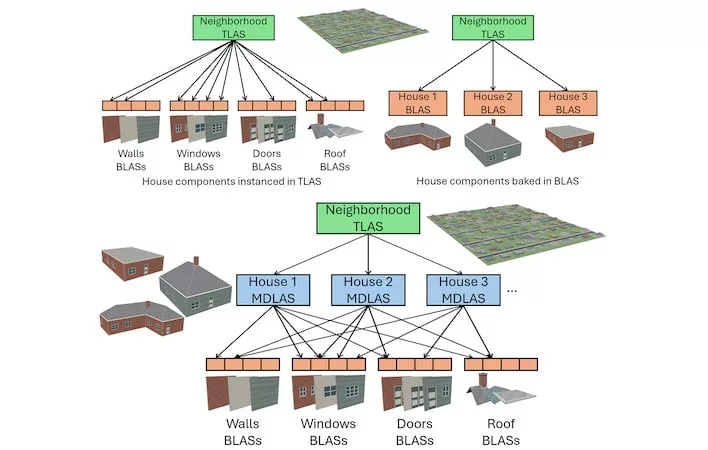
In large, dynamic environments filled with repeated, multi-part assets—such as city blocks composed of modular walls, windows, and doors—this two-tier limit forces developers into a difficult compromise. Instancing every small component individually inside the TLAS saves geometry memory but makes the TLAS massive and slow to rebuild every frame. Conversely, baking entire composite buildings into single BLAS objects keeps the TLAS lean, but duplicates underlying geometry across variations and consumes substantial amounts of VRAM.
How RT-MLAS Solves the Hierarchy Gap
RT-MLAS resolves this bottleneck by introducing a Mid-Level Acceleration Structure (MDLAS), allowing developers to insert up to two intermediate hierarchy layers between the BLAS and the TLAS. Instead of choosing between a bloated TLAS or duplicated BLAS geometry, engines can build BLAS objects for reusable base components, group those components into an MDLAS representing a composite asset (such as a specific house or vehicle model), and then instance that MDLAS across the TLAS.
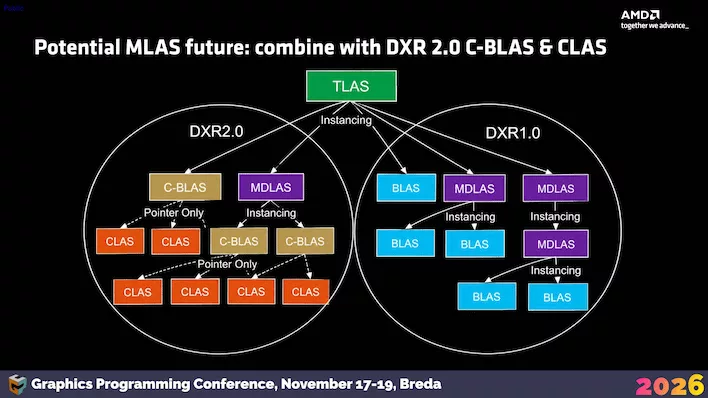
Because MDLAS partitions can also be allocated and updated independently, engines can selectively rebuild or refit localized regions without disturbing static parts of the scene. This provides a significant advantage for managing highly dynamic environments where only certain parts of a complex object might be moving or deforming.
Benchmark Results and Technical Trade-offs
In AMD's demonstration application, which features 10,000 animated Newton's cradles running on a Radeon RX 9070, the efficiency gains were stark. RT-MLAS required just 3.62 MB of acceleration structure memory, compared to 47.17 MB for a per-component BLAS setup (a 92.3% drop) and 11.55 MB for a per-unique-cradle BLAS approach. Median rebuild times also improved, dropping to 0.43 ms from 0.97 ms and 1.60 ms in the respective comparison scenarios.

However, the technique is not a free lunch. The primary trade-off is traversal overhead; adding extra hierarchy layers requires the GPU to step through more organizational nodes per ray. This means that in simpler scenes, the extra complexity might result in diminished returns or even increased computational costs.