

VZMORE brings vapor chamber cooling to Mini PCs
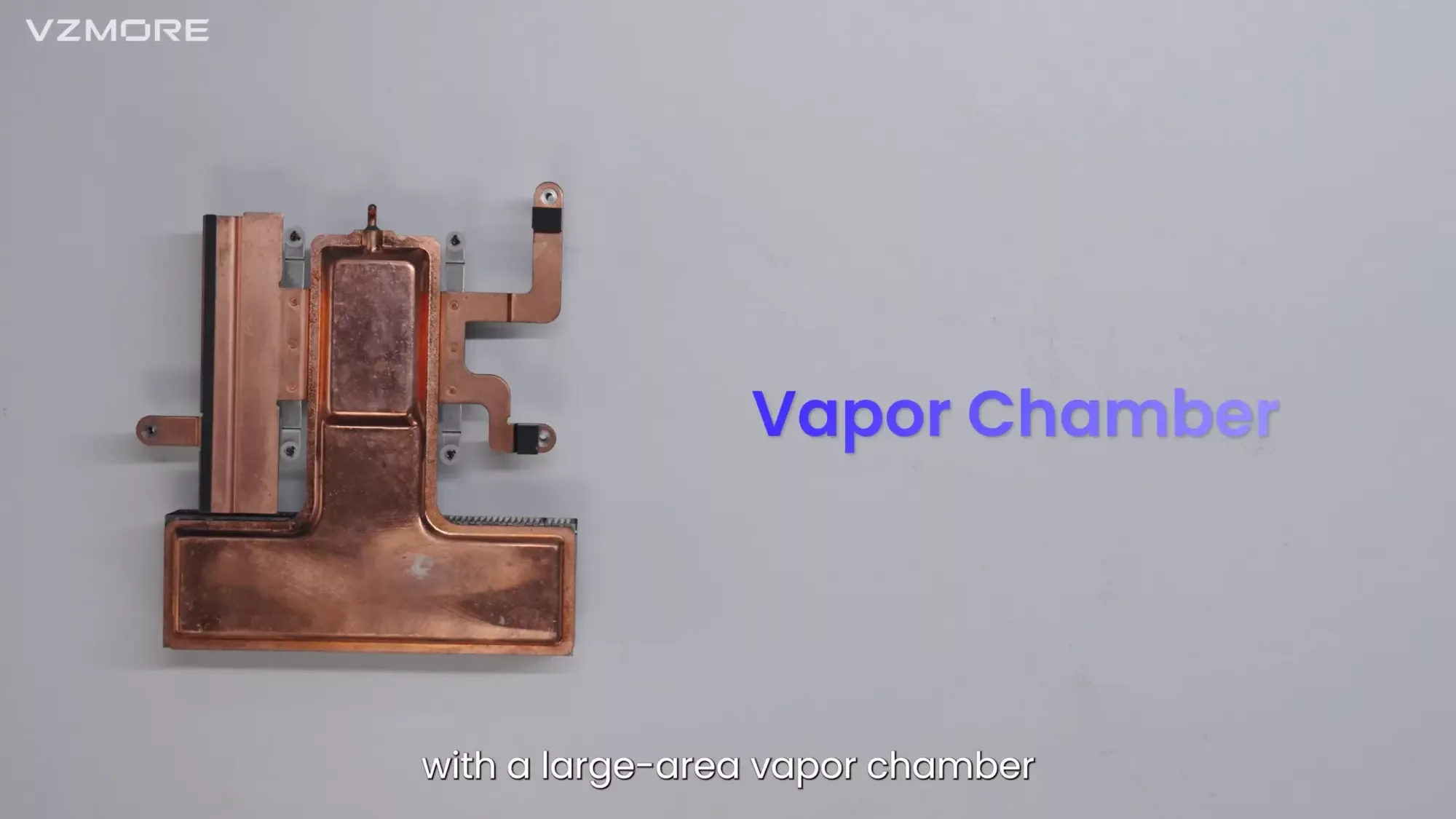
VZMORE has introduced a new cooling architecture called V-Cooling for its Mini PC lineup. The core innovation is the implementation of a large vapor chamber to replace the traditional dual-heat-pipe modules, aiming to address the thermal and acoustic challenges common in small-form-factor systems.
Vapor Chamber vs. Dual Heat Pipes
The V-Cooling design relies on a vapor chamber that utilizes an internal fluid to evaporate, condense, and return via a capillary structure. This mechanism allows heat from the processor to spread across a significantly larger surface area compared to fixed heat-pipe paths. According to VZMORE, this approach provides a 40% larger heat-spreading area and 50% higher heat-transfer efficiency than conventional dual-heat-pipe coolers. However, this performance comes with a higher manufacturing cost, as the vapor chamber module is reportedly roughly three times more expensive to produce than standard heat-pipe designs.
Airflow and Acoustic Performance
The thermal solution works alongside the company's V-Boost performance system. The chassis features a 360-degree bottom air intake, directing air vertically across the processor, motherboard, memory, and SSD before it passes through a high-density fin stack. To minimize noise and vibration, VZMORE has incorporated polymer materials into the fan construction and utilized modified blade geometry.
The company claims that under full load, noise levels can be kept as low as 38 dB, which is approximately 12 dB quieter than the 50 dB typically seen in conventional Mini PC cooling systems. The V-Boost lineup will offer various power configurations, including 45 W, 80 W, and 120 W tiers, with the V-Boost Pro specifically designed to support systems operating at up to 80 W.
Гика
