
Snapdragon 8 Elite Gen 6: 5GHz Clocks and Neural Fusion Graphics
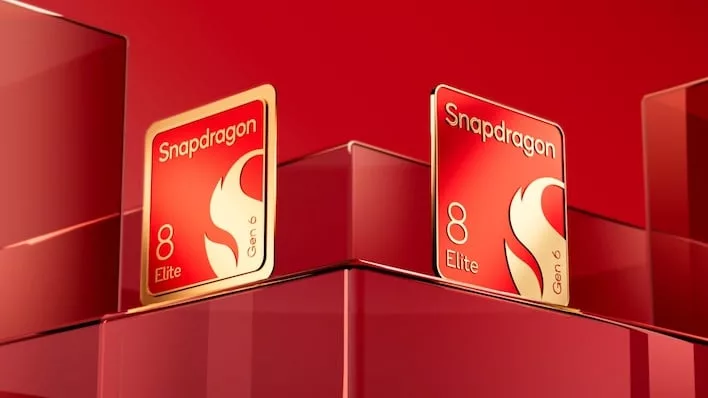
At the Snapdragon Summit, Qualcomm introduced its next-generation flagship silicon, splitting the lineup into two distinct tiers: the standard Snapdragon 8 Elite Gen 6 and the high-end Snapdragon 8 Elite Extreme Gen 6. Built on an unspecified 2nm process, these chips aim to redefine mobile performance through massive clock speeds and specialized AI hardware.
Oryon CPU Hits the 5GHz Milestone
The most striking technical achievement is the Oryon CPU reaching clock speeds of up to 5GHz on its Prime cores. This marks the first time a mobile CPU has hit such a frequency. The architecture maintains an eight-core configuration: two Prime cores at 5GHz and six Performance cores at 4GHz. A key innovation is the Oryon Flex Cache (16MB), a dynamically allocated shared cache pool. This allows Prime cores to access the entire cache capacity during heavy workloads, reducing latency by preventing data spills into external memory.
Despite the aggressive clock speeds, Qualcomm reports a 37% increase in CPU power efficiency compared to the previous generation, largely attributed to the transition to a 2nm process. The platform supports LPDDR6 memory (up to 5300MHz) and UFS 5.0 storage, with configurations reaching up to 24GB of RAM.
GPU and AI: The Extreme Distinction
The primary differentiator between the two chips lies in their graphics and neural processing capabilities. While the standard Gen 6 features a next-gen Adreno GPU, the Extreme model introduces dedicated Adreno Matrix Cores. Similar to NVIDIA's Tensor Cores, these are AI-dedicated units integrated directly into the graphics pipeline. This enables Adreno Neural Fusion, a technology that combines AI-driven super resolution and frame generation (analogous to DLSS or XeSS) directly within the rendering flow.

To support these heavy workloads, the Extreme model includes 18MB of Adreno High Performance Memory (HPM). This low-latency, on-chip memory structure keeps frame buffers and compute data local to the GPU, minimizing system memory traffic. This hardware-level optimization is designed to handle advanced features like Unreal Engine 5's Lumen and Nanite, alongside hardware-accelerated ray tracing.
Agentic AI and Next-Gen Connectivity
The Hexagon NPU has been redesigned to support "Agentic AI"—systems capable of executing multi-step tasks rather than just responding to single prompts. The NPU features a larger shared-memory subsystem and specialized accelerators for transformer workloads. Qualcomm claims the platform can run Mixture-of-Experts (MoE) models with over 30 billion total parameters, utilizing roughly 3 billion active parameters per token generation step.
Connectivity receives a massive boost with the X105 5G Modem-RF system, supporting 5G Advanced with peak downlink speeds of 14.8Gbps. It is also 3GPP Release 19 ready, paving the way for satellite connectivity. Additionally, the new FastConnect 8800 system introduces support for Wi-Fi 8 (up to 11.6Gbps) and Bluetooth 6.0, enhancing the device's ability to interact with its surrounding ecosystem.
The Motorola Signature 27 is expected to be among the first devices to utilize the Snapdragon 8 Elite Extreme Gen 6, featuring an advanced ArcticMesh cooling system to manage the high-performance 2nm silicon.
Гика
