PCIe 6.0 for Enterprise SSDs: Silicon Motion SM8466 Hits 28 GB/s and 7 Million IOPS
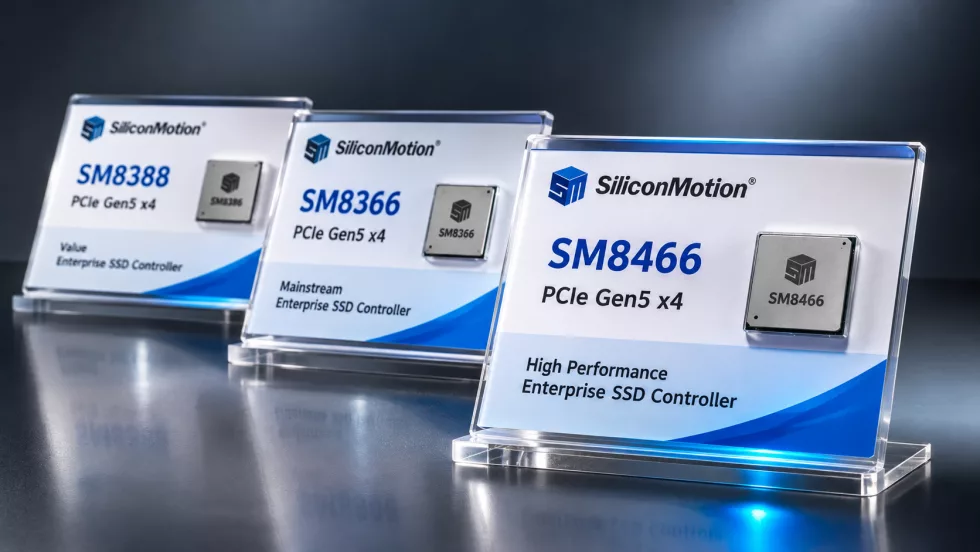
At the SC26 event, Silicon Motion showcased its SM8466 enterprise SSD controller, marking a significant leap into the PCIe 6.0 era. Designed specifically for data-intensive environments like AI infrastructure and large-scale data centers, the controller promises sequential throughput of up to 28 GB/s and a staggering 7 million random IOPS, with support for capacities exceeding 512 TB.
The introduction of PCIe 6.0 represents a major shift in interface bandwidth, utilizing PAM4 (Pulse Amplitude Modulation 4-level) signaling to significantly increase raw data rates compared to the previous PCIe 5.0 standard. While current high-end consumer NVMe SSDs typically peak around 14 to 15 GB/s, the SM8466 approaches the practical bandwidth limits of a PCIe 6.0 x4 connection. This jump in speed is aimed squarely at enterprise workloads where massive parallel data streams are the norm.
Targeting AI and Massive Parallelism
The most striking specification is the 7 million random IOPS. For typical desktop users, such numbers are largely irrelevant, as software access patterns and latency often become bottlenecks long before reaching these levels. However, in large-scale AI and database systems, massive parallel access creates extremely high queue depths. This makes the SM8466 ideal for scenarios where millions of independent I/O operations occur simultaneously—a requirement increasingly driven by AI workloads involving massive model weights, training datasets, and the need to swap KV-caches or other data structures from RAM to flash storage.
To support capacities beyond 512 TB, the platform will likely rely on high-density QLC NAND and enterprise-grade form factors. This positions the SM8466 not as a consumer-grade component, but as a core element of storage systems designed to combine immense capacity with extreme parallelism.
Quality of Service and Technical Challenges
Beyond peak performance, enterprise environments demand consistent Quality of Service (QoS). Silicon Motion has introduced its PerformaShape QoS technology, which aims to ensure predictable performance and low latency even under heavy loads. While the company claims this will prevent latency spikes during intense I/O operations, independent measurements and real-world testing are not yet available. Additionally, the transition to PAM4 signaling increases the complexity of controller design, as the four-level voltage states are more sensitive to signal interference than the two-level signaling used in previous generations, necessitating advanced error correction and signal processing.
While the raw numbers are impressive, several key details remain unconfirmed. Silicon Motion has not yet disclosed specific DWPD (Drive Writes Per Day) ratings, the exact NAND generations to be used, or the controller's power consumption. For drives reaching several hundred terabytes, these metrics will be just as critical as the headline-grabbing 28 GB/s throughput.