
Philips Evnia M4: QHD Monitors Up to 425 Hz with New Circularly Polarized Backlight
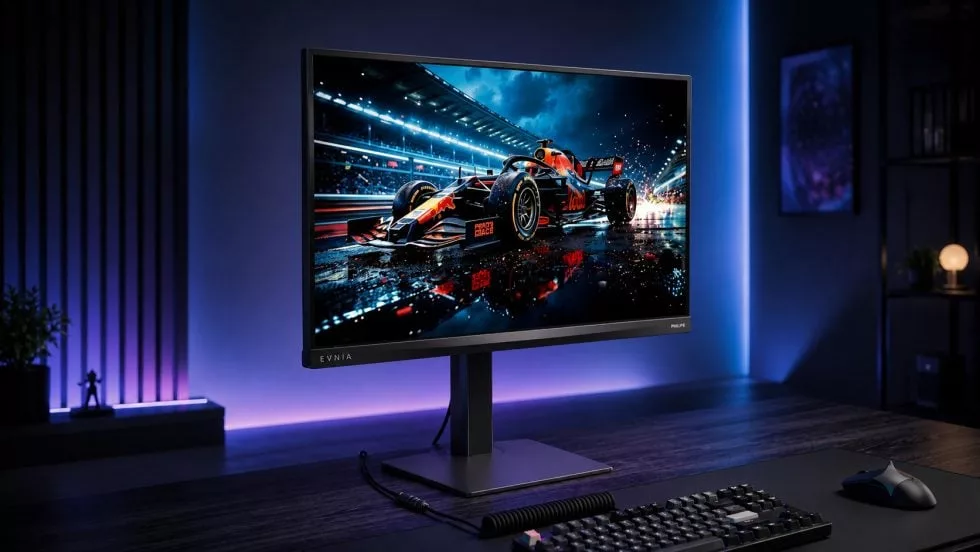
The company states that the combination of high refresh rates and QHD resolution is aimed at fast PC gaming. However, it is important to note that the 425 Hz mode only makes sense if the CPU and GPU can deliver several hundred frames per second (FPS) in the games being used. This is most realistic for esports titles with reduced graphics details.
425 Hz is an Overclocking Mode
In the 27M4P5501X, Philips distinguishes between 400 Hz as the regular maximum refresh rate and 425 Hz as an overclocking mode. Official specifications confirm support for QHD (2560×1440) at both frequencies via DisplayPort 1.4 and HDMI 2.1 interfaces. At 425 Hz, the image updates every ~2.35 ms, whereas at 320 Hz it is approximately 3.13 ms. The difference of less than a millisecond can be relevant in competitive games but is significantly smaller than the jump from classic 60 Hz to 144 or 240 Hz.
The manufacturer specifies a typical pixel response time (Grey-to-Grey) of 1 ms. The advertised value of 0.3 ms belongs to the Smart-MBR mode for motion blur reduction and is not equivalent to a standard GtG measurement. The panels use Fast IPS technology, which avoids issues like burn-in common with OLEDs but does not automatically achieve the pixel switching speeds of modern OLED gaming panels.
For the 27M4P5501X, Philips specifies a typical brightness of 400 nits and a static contrast ratio of 2000:1. For an IPS panel, a stated contrast of 2000:1 is relatively high; however, independent measurements will show whether this value is achieved uniformly across the screen area. Color reproduction covers 98% DCI-P3 and 100% sRGB with a Delta E deviation under 2 in sRGB mode.
Circularly Polarized Backlight
The most unusual feature of the series is the circularly polarized backlight. Philips claims that the light distribution of this technology is closer to natural sunlight compared to classic linearly polarized LCD outputs. The technology is TÜV Rheinland certified and is positioned as a way to reduce visual discomfort during long sessions. It is important to understand that this is not a medical effect but a subjective sensation that may vary depending on individual perception.
Low-Blue Light with 48 Zones
In addition to polarization, Philips uses a dynamic Low-Blue Light solution. An integrated chip divides the image into 48 zones and adapts light output segmentally to reduce intense blue components without globally shifting the color temperature of the entire screen (which often makes white appear yellowish). Philips does not publish independent spectral measurements or comparative data for different operating modes.
The monitors support standard LowBlue and Flicker-Free functions. The series is certified under VESA DisplayHDR 400, which is the entry-level class of HDR certification. This should not be confused with the performance of current OLED or Mini-LED displays with local dimming and peak brightness in the thousands of nits. For competitive gaming, HDR is often disabled for better visibility, but support can be beneficial in single-player titles.
AI PQ and Other Features
Philips lists "AI PQ" as part of the series. It is supposed to reduce motion blur and upscale low-resolution content. However, the manufacturer does not disclose the model architecture, training data, or computational power. Technically, this should be understood as the manufacturer's own image processing function.
Additional features include Stark Shadow Boost, Smart Crosshair, Smart Sniper, and Smart MBR Sync. They can be helpful in games but alter the original image or overlay elements on top of it. For graphic work or video playback, neutral settings are preferable.
Connectivity is provided via two HDMI 2.1 ports and one DisplayPort 1.4. Philips states support for 425 Hz at QHD resolution for both interfaces, which requires the corresponding bandwidth from the cable and graphics card. For the 425 Hz mode, an 8-bit color depth is used with Display Stream Compression (DSC) on DisplayPort and FRL on HDMI.
The 27M4P5501X supports AMD FreeSync and G-SYNC Compatible, allowing the monitor's refresh rate to be synchronized with variable frame rates. This is critical for QHD resolution at high frequencies to avoid image tearing. The exact VRR operating range is not fully disclosed.
The lineup consists of three models: 27M4P5501X (up to 425 Hz), 27M4P5501U, and 27M4P5500U (up to 320 Hz). All combine QHD, Fast IPS, new polarization, HDR 400, and image processing functions. Philips has not announced a unified global launch date, and prices in Germany are not yet specified.
Гика
