
NVIDIA DGX Spark: Less Memory, Higher Price
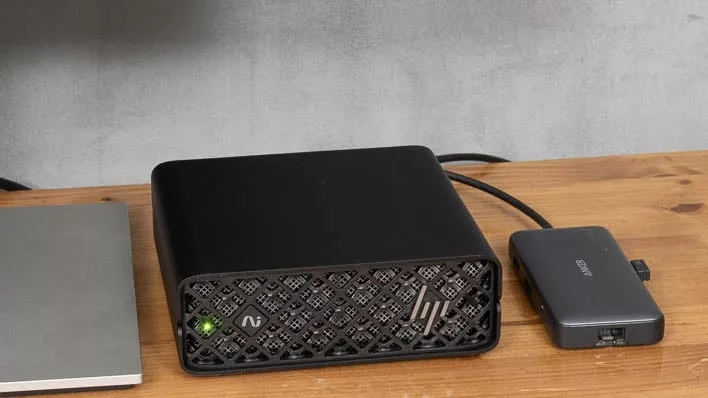
The era of immunity to component shortages seems to be over for NVIDIA. Despite the rising demand for NAND and DRAM, the DGX Spark is facing a double blow: a reduction in memory capacity and a simultaneous increase in retail price.
Spec Cuts Amidst Rising Costs
NVIDIA has announced a new 64 GB LPDDR5x version of the DGX Spark. This is not a new product line, but rather a pared-back version of the existing hardware. The system retains its core features, including the "ConnectX7" LAN chip with dual QSFP ports supporting 200 Gbps networking. This high-speed connectivity remains vital for 64 GB users, as they will likely need to cluster multiple units to handle larger workloads.

The pricing shift is notable. While the original MSRP was $4,699, the new 64 GB models from partners like Dell (specifically the Pro Max with GB10) are priced at $4,999. Meanwhile, the 128 GB variant has seen a significant jump to $6,995, aligning it with other partner systems like the HP ZGX Nano G1n.
Impact on AI Workloads
The reduction to 64 GB of RAM changes the landscape for local AI deployment. Mid-sized models like Qwen 3.8 27B or Nemotron 3.5 Lightning 30B-A3B will still fit, though performance on a 256-bit LPDDR5x bus can be limited for dense models. However, hybrid Mixture-of-Experts (MoE) models, such as Nemotron 3.5, tend to perform much more efficiently in these environments.
The real loss is felt when running models exceeding 80 billion parameters, such as Qwen 3.8 Flash Next, which cannot fit into the 64 GB limit. However, a potential silver lining is the industry shift toward offloading parts of a model—like 51B parameter dictionaries—directly from storage. As this technique becomes standard, the utility of 64 GB systems may extend to larger models.
The new 64 GB GB10-based systems from partners including MSI, ASUS, Gigabyte, and Acer are expected to be available starting October 23, 2026.
Гика
