

NBA 2K27 debuts DLSS 5 with realistic visuals but heavy performance cost
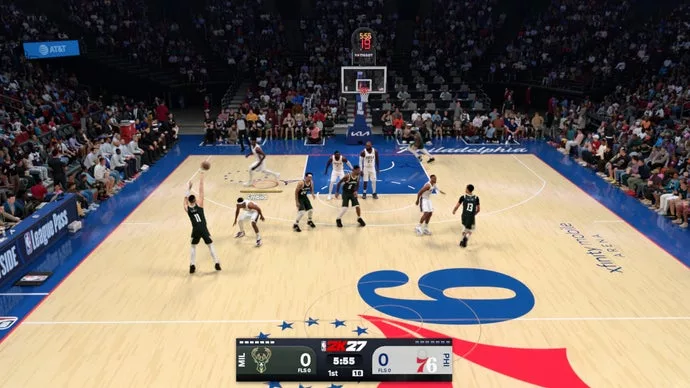
Nvidia's latest AI rendering technology, DLSS 5, has made its live game debut in NBA 2K27, delivering visuals that are far less problematic than feared—provided you are running it on the top-tier hardware it demands.
After months of justified revulsion and anti-anticipation surrounding Nvidia's AI rendering tools, the tech is finally available in a live game. The subject is NBA 2K27, a license-laden basketball sim, and the verdict is that it looks... maybe not that bad? While this 'not-that-badness' comes at an enormous cost to performance, the implementation is currently inoffensive in the looks department.
DLSS 5 currently has official support only on RTX 50 series graphics cards. Testing was conducted on two setups: an RTX 5080 at 1440p and an RTX 5050 at 1080p, both running Ultra settings with ray-traced reflections and Quality-level DLSS upscaling enabled. On both configurations, it is hard to argue that DLSS 5 ruins the artistic intent of the game.
The technology helps significantly because NBA 2K27's goal is photorealism, which aligns with Nvidia's explicit raison d'être for DLSS 5. Your brain expects players to resemble their real-life counterparts; therefore, when DLSS 5 makes skin textures slightly sweatier or vests more detailed, it does not look wrong. To the eye, there is none of the artificial, overly glossy smoothness typical of fully generative AI visuals.
Crucially, there are few signs of the excess detailing and outright errors evident in pre-release material. Facial structures appear unchanged—there is no evidence DLSS 5 reshapes character model geometry—and darker skin tones aren't uncomfortably lightened. While the original reveal included a warping football suggesting frame-gen-style problems with fast-moving objects, the ball in the hands of a sprinting dunkman remains steadfastly spherical.
Zoomed out with the default game camera, it becomes hard to tell where DLSS 5 is having an effect and where it isn't. It appears developers Visual Concepts have used its masking feature to apply neural rendering to objects selectively, rather than essentially whacking a filter over the entire image. This makes DLSS 5 still look like a game here, rather than an AI-generated approximation of one.
Whether that stays true in other games—those that don't share NBA 2K27's love of photorealism—remains to be seen. DLSS 5 sidesteps many ethical problems with generative AI: its machinations take place on your GPU, instead of an earth-shattering data centre, and it functions as a glorified upscaler for existing art, rather than pretending to be original art itself.

However, DLSS 5 has a more immediate drawback: performance. The RTX 5080 lost 54% of its NBA 2K27 framerate at 1440p: an average 211fps dropped to 98fps with a single flick of the neural rendering toggle. With the diminishing returns of ultra-high framerates, that may not be ruinous in practice.
The RTX 5050, however, took a sound thrashing at 1080p. 137fps with Ultra settings and ray tracing plummeted to 44fps with DLSS 5 enabled—a 67% performance tax. As reassuring as it is to see the tech's visuals showing some restraint, you can't really say it looks 67% nicer.
NBA 2K27 has DLSS 4's Multi-Frame Generation (MFG) to make up the difference, though this genuinely is too much AI, too fast. While MFG objectively gets the numbers up—3x mode averaging 99fps on the RTX 5050 and 6x mode reaching 135fps—it still hurls back in your face all the same vexations that frame generation has produced since DLSS 3.
3x mode was enough to distort details; you can see the bending player ID tag and the ball thrower's disintegrating hand in screenshots. While 6x added nastily edge distortions and ghosting effects. Considering the whole point of DLSS 5 is to make games look more realistic, MFG evidently isn't the answer to its frame hunger, and that's even before getting into frame gen's added input lag.
It is told that Nvidia are actively working to improve DLSS 5 performance on 50 series cards, after which they'll switch focus to RTX 40 series support. That is fine, though for all the grossness of that original reveal and all the subsequent charm offensives about respecting intent, it's almost funny that NBA 2K27's launch version of DLSS 5 is basically just the equivalent of path tracing with extra machine learning.
All the same, it could have been so, so much worse. A factually accurate hater would admit that a DLSS 5-ified NBA 2K27 still looks like NBA 2K27, mainly just with extra pores and perspiration. It is a decent start, aesthetically, even if it still has much to prove in future implementations.
Флешка
