

DirectX Raytracing Update: Microsoft Could Slash VRAM Use by Up to 90%
Microsoft introduces major DXR updates, including Clustered Geometry and Partitioned TLAS, aiming to optimize ray tracing performance and memory usage.

Microsoft is bringing what it calls the most significant update to DirectX Raytracing (DXR) since its 2018 debut. The update targets the massive computational and memory overhead inherent in ray tracing. By standardizing technologies previously used in proprietary solutions like NVIDIA's RTX Mega Geometry, Microsoft aims to bring these performance gains to the broader DirectX ecosystem, allowing developers to implement them across various hardware vendors.
The update revolves around three core features: Clustered Geometry (CLAS), Partitioned TLAS (PTLAS), and GPU-driven acceleration structure builds. Efficient real-time ray tracing relies on acceleration structures—smart approximations of a scene that allow game engines to rapidly discard sections during ray-triangle intersection tests. The new features aim to make these processes significantly more efficient.
CLAS utilizes triangle clustering to accelerate intersection tests, while the new ExecuteIndirectRTASOperations() function enables the GPU to execute batches of acceleration structure operations using data stored in GPU memory, bypassing the CPU. Perhaps the most impactful addition is PTLAS. Instead of rebuilding massive, scene-wide acceleration structures whenever objects move, PTLAS allows the engine to partition the scene and update only the affected segments. This is a major optimization for open-world environments and scenes with high levels of dynamic objects.
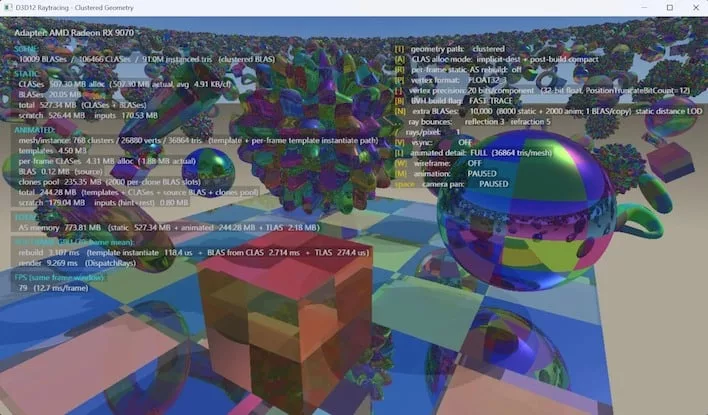
Benchmark Results and Real-World Impact
In a microbenchmark conducted on a Radeon RX 9070 XT, Microsoft reported a 7.83x speed-up in per-frame GPU ray tracing and an 89.7% reduction in video memory usage for acceleration structures. Microsoft clarifies that these extreme gains are based on a targeted 'test playground' and real-world games are unlikely to see such massive improvements, but the underlying efficiency gains remain significant.
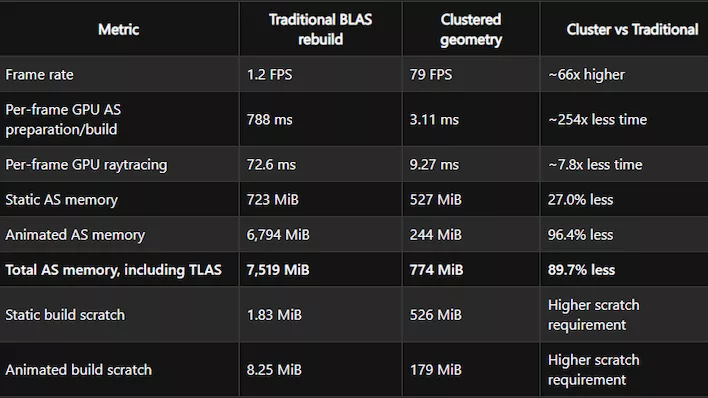
While the hardware support for these features already exists across major vendors, the actual impact on gaming will depend on developer implementation. Notably, support for these techniques is also expected to arrive for Qualcomm's Adreno mobile GPUs next year.
Гика
