Kioxia and NVIDIA Test 144 SSDs to Expand AI GPU Memory Beyond 1 PB
As AI data center expansions accelerate and datasets grow at an unprecedented pace, the industry is facing a critical shortage of available memory. To address this bottleneck, Kioxia and NVIDIA have demonstrated a proof of concept that moves beyond simply adding more expensive high-bandwidth memory (HBM) to GPUs. By utilizing an array of 144 solid-state drives (SSDs), the two companies have shown how effective GPU memory capacity can be extended to over 1 petabyte (PB).
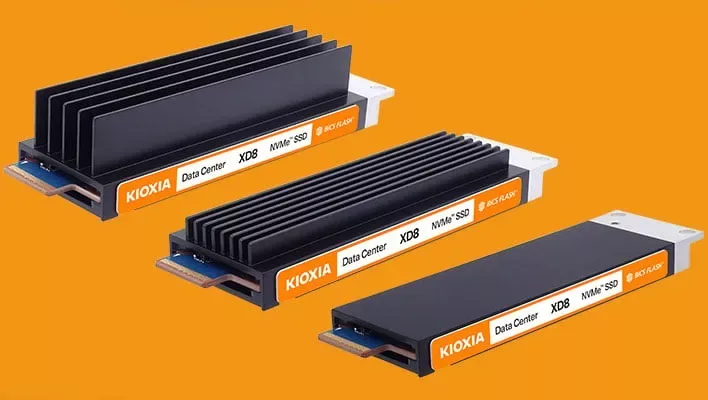
The demonstration was centered on NVIDIA's GB200 NVL72 rack-scale system, which is built on the Blackwell architecture. The configuration utilized 18 server nodes paired with 144 of Kioxia's XD8 Series 7.68TB E1.S NVMe SSDs. This setup provides approximately 1.1PB of raw flash storage capacity, offering nearly 60TB of extended memory capacity per node.
How SCADA Bridges the Gap Between Storage and HBM
The core mechanism enabling SSDs to assist GPUs in overcoming HBM limitations is a technology called NVIDIA SCADA (Scaled Accelerated Data Access). By leveraging NVMe storage—specifically Kioxia's XD8 series in this instance—and NVIDIA's Storage-Next technologies, this software library allows GPUs to access datasets significantly larger than their onboard HBM capacity would normally permit.
According to Jason Hardy, VP of Storage Technology at NVIDIA, the intelligence of AI agents is increasingly tied to the breadth of knowledge they can access rather than just raw compute power. He noted that through innovations like SCADA and Storage-Next, NVIDIA aims to work with partners like Kioxia to improve memory efficiency and unlock new levels of intelligence by enabling access to vastly larger knowledge bases.
Scaling for Massive Vector Databases
The potential scale of this architecture is substantial. Kioxia stated that the proof of concept supports data access in chunks as small as 512 bytes. This architecture could potentially accommodate a database containing up to 2 trillion 512-byte vectors. Such capacity is particularly relevant for massive vector databases and graph neural networks (GNNs), where datasets often exceed the available HBM capacity.
Neville Ichhaporia, Senior Vice President and General Manager of the SSD business unit at KIOXIA America, Inc., emphasized that the ability to work with massive datasets is becoming critical as AI applications advance. He noted that the collaboration demonstrates how Kioxia’s flash storage technology can contribute to new approaches for scaling AI data processing.
While the results are impressive, it is important to note that this remains a proof of concept. Kioxia and NVIDIA are currently continuing to evaluate the technical feasibility and real-world performance of the SCADA technology.