FSR 4.1.2 for Unreal Engine: AMD Brings ML Upscaling to Radeon RX 6000 and Ryzen Handhelds
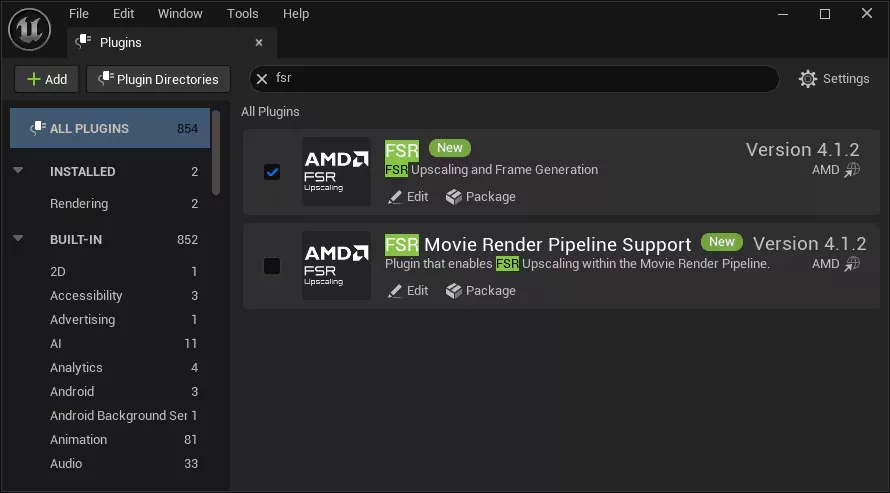
AMD has updated its Unreal Engine plugin to support FSR Upscaling 4.1.2, significantly expanding the reach of its machine learning (ML)-based upscaling technology. While previously tied more closely to newer architectures, the update now brings ML-driven FSR to discrete Radeon RX 6000 series GPUs and several Ryzen-based handheld platforms, including Ryzen AI Max and Ryzen AI 9 processors.
The update, based on the FSR "Redstone" SDK 2.4, supports Unreal Engine versions 5.3 through 5.8. The primary technical shift in this release is the expansion of hardware compatibility. Beyond the high-end Radeon RX 9000 and RX 7000 series, the plugin now accommodates discrete Radeon RX 6000 graphics cards and selected Ryzen processors with integrated Radeon graphics, specifically targeting the Ryzen AI Max, Ryzen AI 9, and multiple Ryzen Z2 platforms designed for gaming handhelds.
Two INT8 Models for Desktops and Handhelds
To manage the diverse range of supported hardware, AMD is utilizing two distinct INT8 models within FSR Upscaling 4.1.2. Discrete Radeon RX 6000 GPUs and Ryzen AI Max chips will utilize the full-sized model to ensure maximum quality. In contrast, less powerful integrated GPUs—such as those found in the Ryzen AI 9 300 and 400 series or various Ryzen Z2 platforms—will use a more compact model described by AMD as being less than half the size of the full version.
This tiered approach allows developers to implement a single integration that covers everything from the RX 9000 down to various current Ryzen iGPUs, rather than maintaining separate upscaling paths for each generation. On unsupported hardware, the system will automatically fall back to FSR 3 as an analytical solution. This move marks a technical departure from the initial exclusivity of the ML version to the RDNA 4 architecture, as AMD progressively rolls out the technology to RX 7000 and now RX 6000 users.
For handheld users, this expansion is particularly significant. Since internal rendering resolutions in handhelds are often substantially lower than the physical panel resolution, the quality of the upscaling algorithm becomes a critical factor in perceived visual fidelity.
Technical Implementation and Limitations
The plugin integrates FSR via the AMD FSR API, which theoretically allows games to receive newer FSR versions through driver updates without requiring constant game patches. However, this long-term functionality depends on AMD maintaining consistent interfaces in future SDK versions. Currently, there is a notable limitation regarding Vulkan: while the FSR SDK 2.4 supports upscaling and Frame Generation via Vulkan, the current Unreal Engine 4.1.2 plugin does not yet provide this support, leaving DirectX 12 as the primary path for UE integration.
The package also includes FSR Frame Generation 4.0.2 and Frame Generation Swapchain 4.0.0. On Radeon RX 9000 series cards, the Swapchain can utilize Driver-Assisted Frame Pacing (requiring Adrenalin 26.10.1 or newer). This feature allows the driver to assist in presentation control to smooth out frame delivery and reduce CPU overhead, though this specific optimization is not automatically applied to the RX 6000 series or the smaller Ryzen iGPUs.