DLSS 5 Brings Lifelike Lighting and Detail to Where Winds Meet
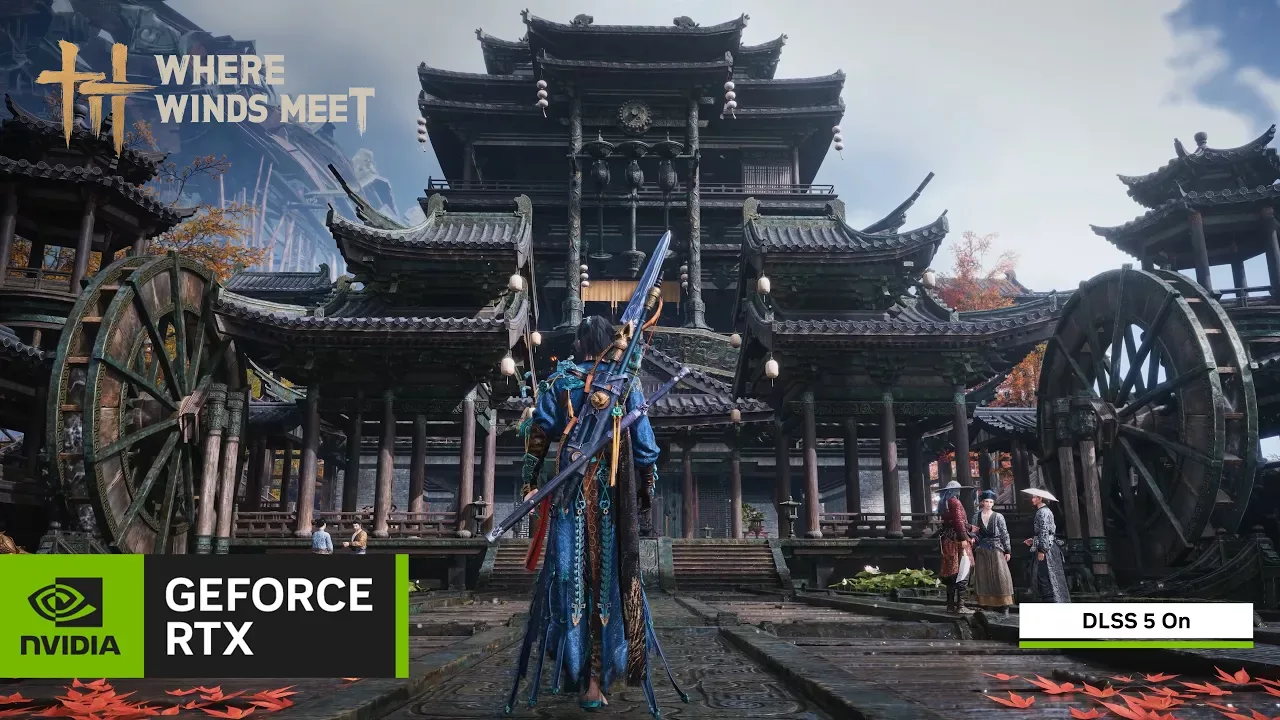
NVIDIA has announced that Where Winds Meet, the Wuxia open-world action-adventure RPG from Everstone Studio, now supports DLSS 5. This implementation introduces 3D-Guided Neural Rendering, a technology designed to move beyond simple frame generation and upscaling by using AI to infuse game scenes with lifelike lighting, subsurface scattering, and enhanced material details.
Following its deployment in titles like NBA 2K27, Hogwarts Legacy, and War Thunder, DLSS 5 is making its way into more high-profile releases. In Where Winds Meet, the technology is powered by an AI model that is twice as fast for GeForce RTX 50 Series GPUs, RTX Spark systems, and GeForce NOW. While the game already featured DLSS Super Resolution and Multi Frame Generation, the addition of DLSS 5 adds a new layer of visual fidelity focused on the actual rendering of light and surfaces.
Visual Impact: Beyond Sharpness
According to Everstone Studio, the primary benefit of DLSS 5 is the ability to achieve higher visual realism through improved highlights, refined shadows, and a new level of microcontrast. Rather than just sharpening an existing image, the technology works alongside the game engine to enhance the scene's lighting and material properties.

Muzi Li, Art Director at Everstone Studio, explained that the technology allows developers to explore lighting and materials more deeply. The AI identifies and tones down overly bright highlights while bringing out more detail in those areas, and it fills in ambient-light details and subtle highlights in the shadows. This process recognizes the specific properties of materials, such as how light interacts with different surfaces.
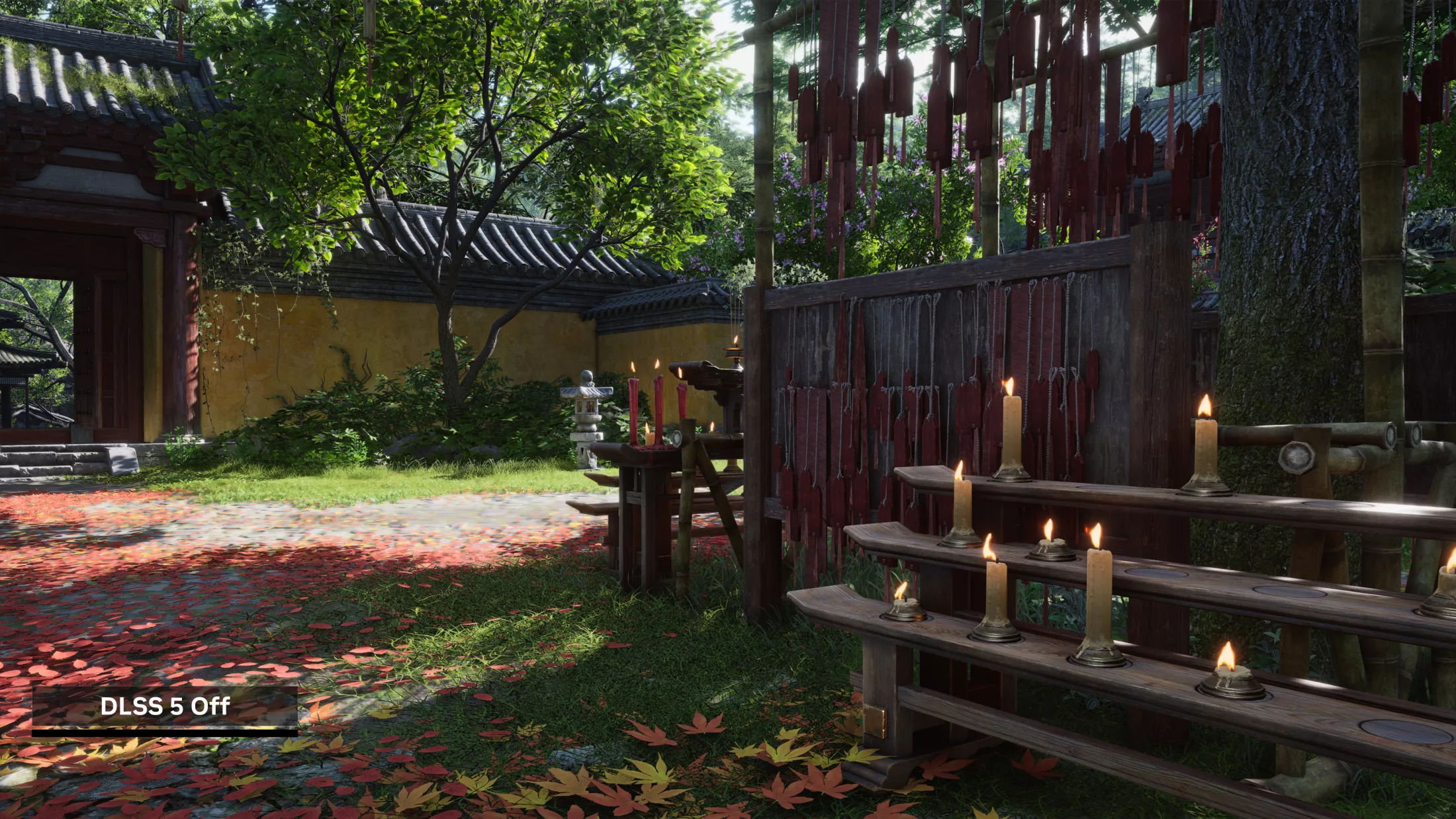
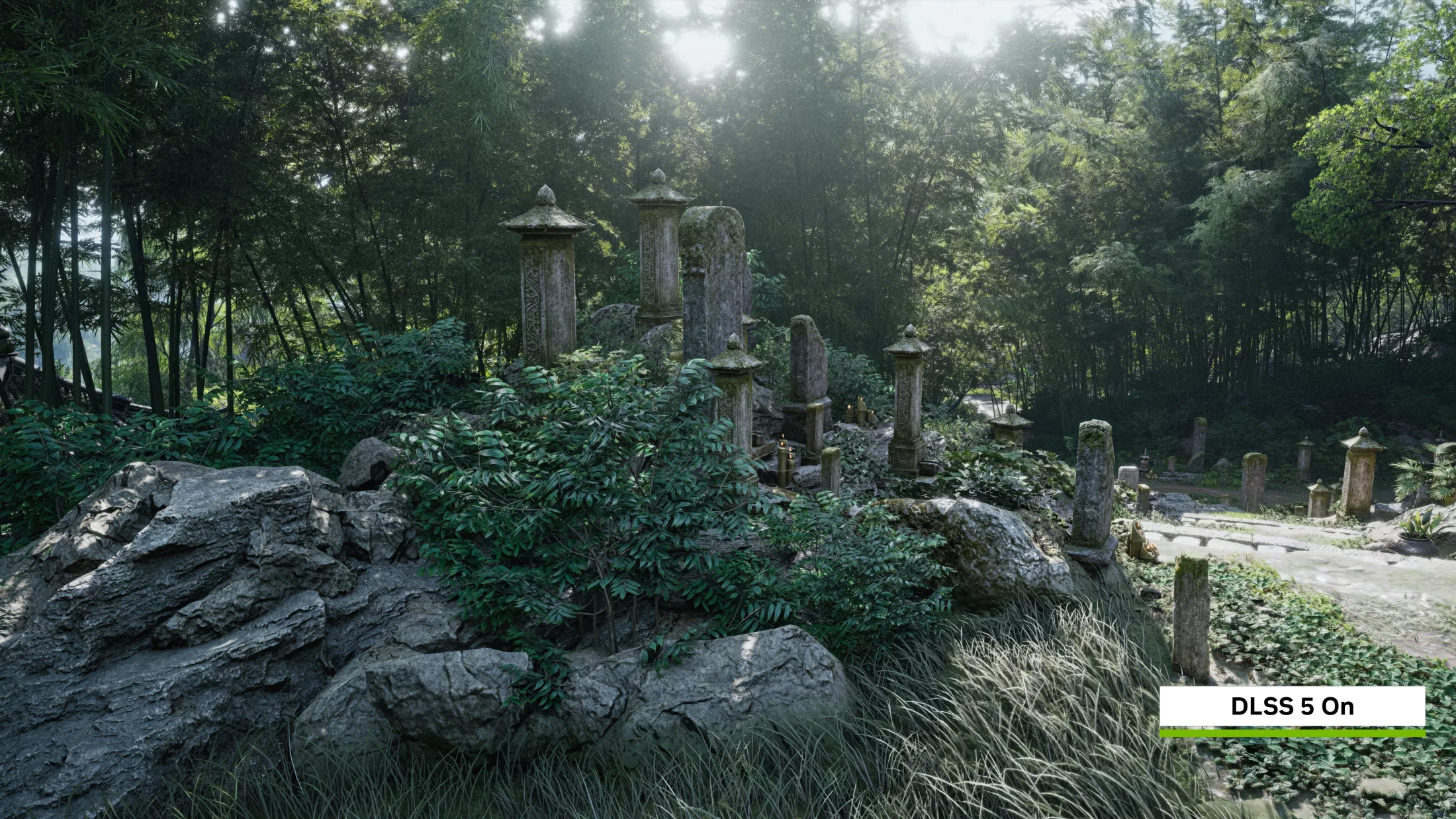
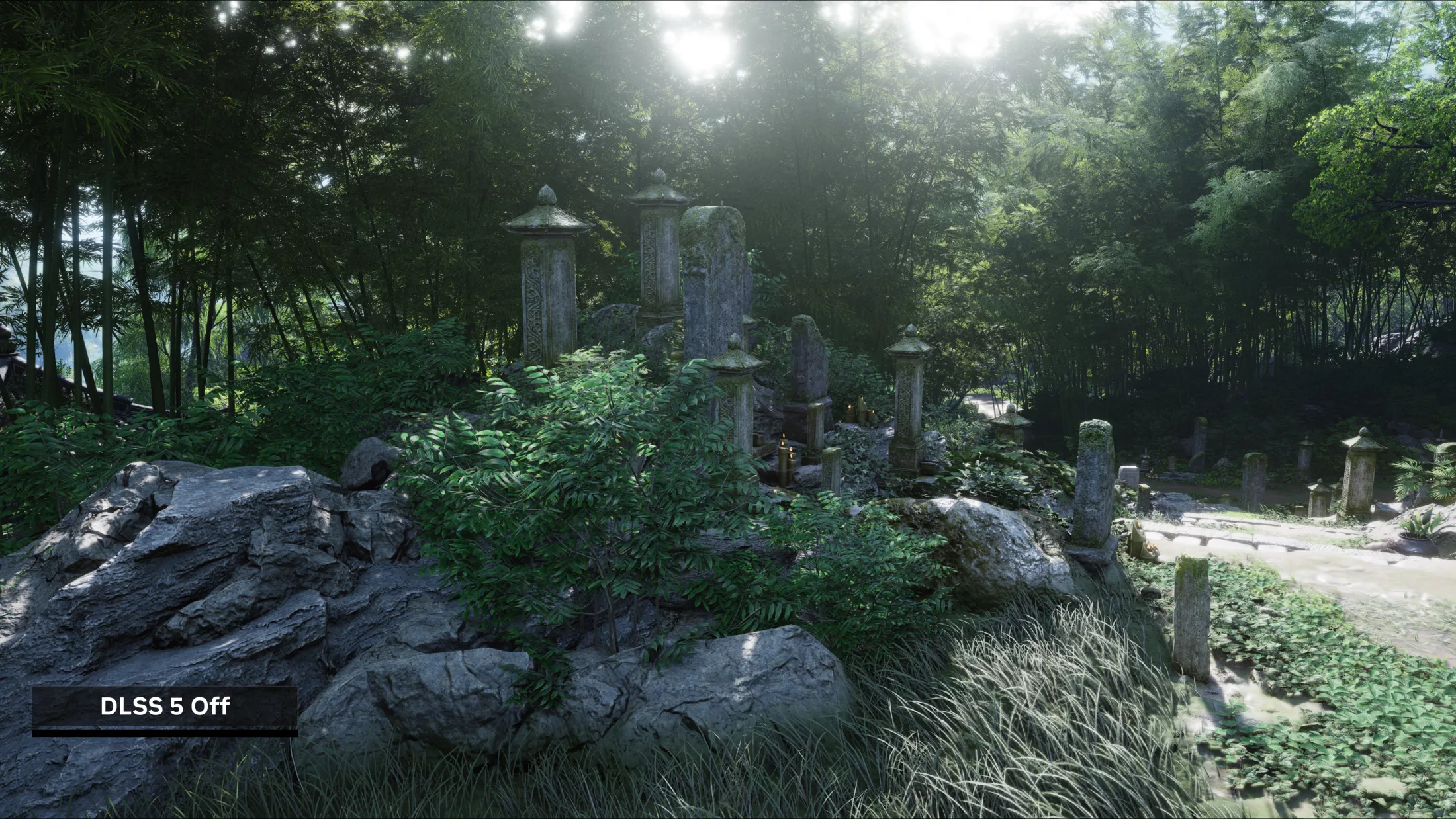
In practical application within Where Winds Meet, this manifests in several ways: candles exhibit accurate subsurface scattering, where light penetrates the wax to create a warm, translucent luminance. Vegetation and foliage benefit from improved light interaction, such as sunlight filtering through translucent leaves to create a green glow. The technology also improves localized lighting on stone monuments and enhances ambient occlusion and global illumination across the environment.
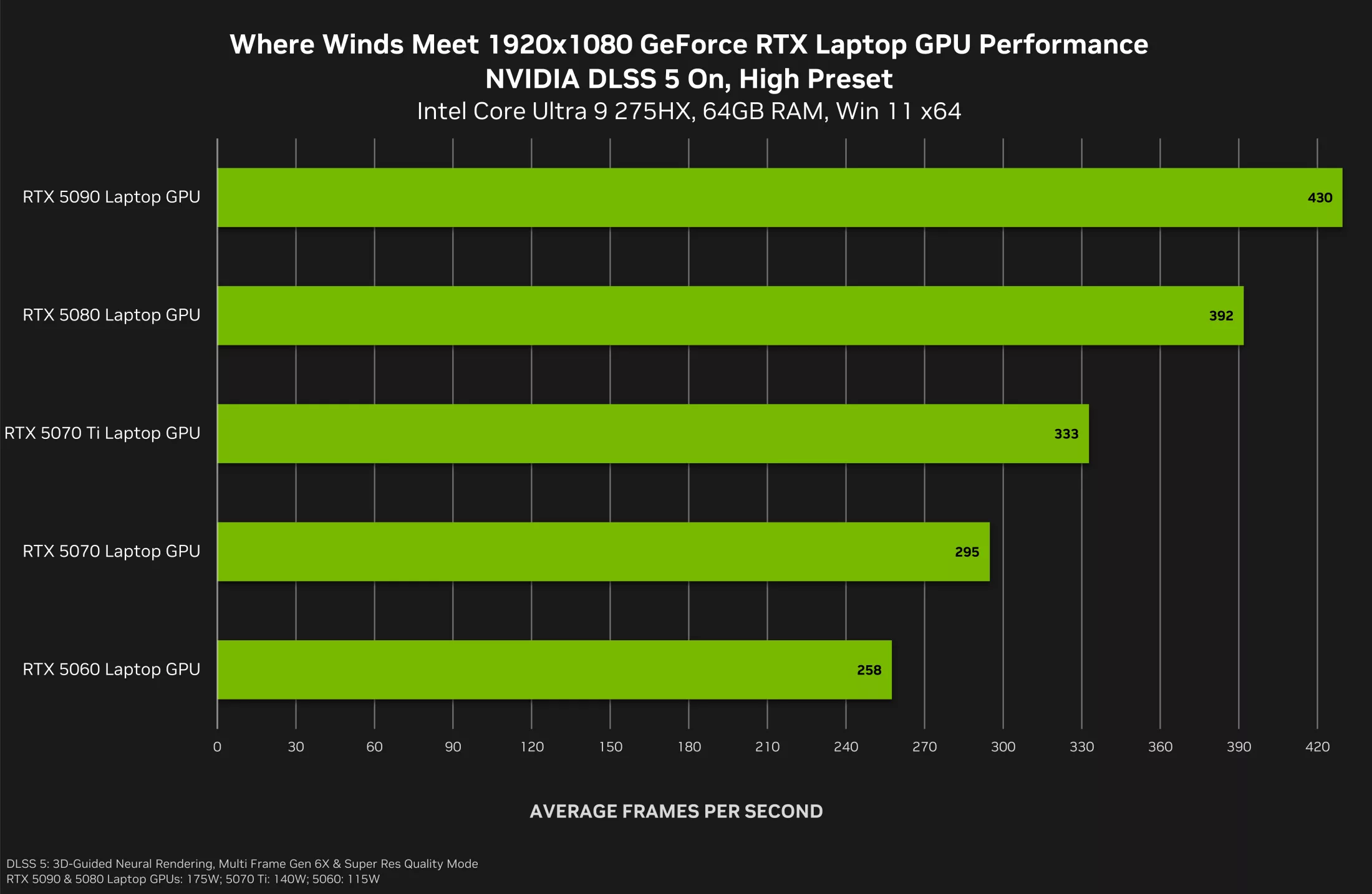
Performance Benchmarks
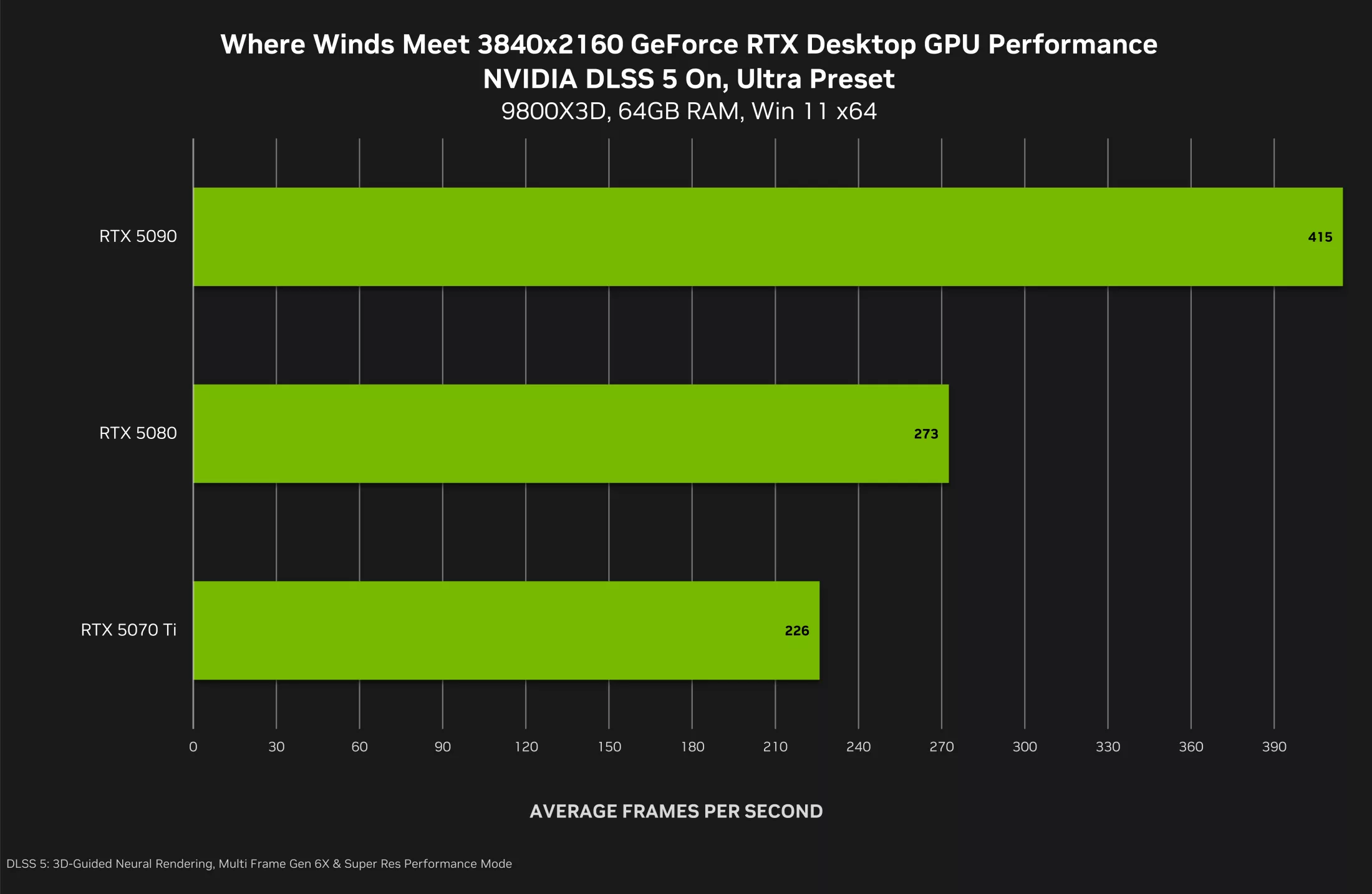
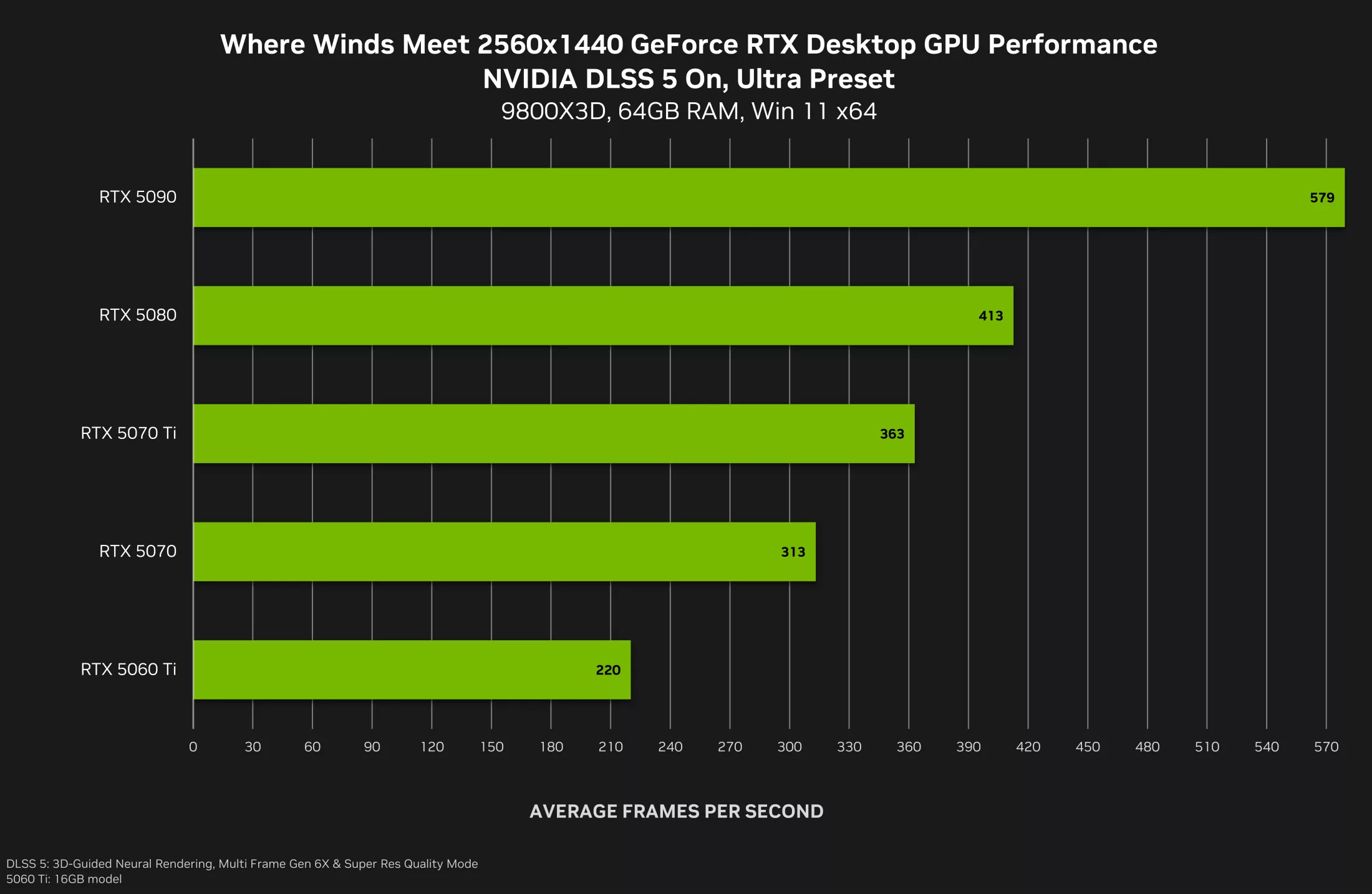
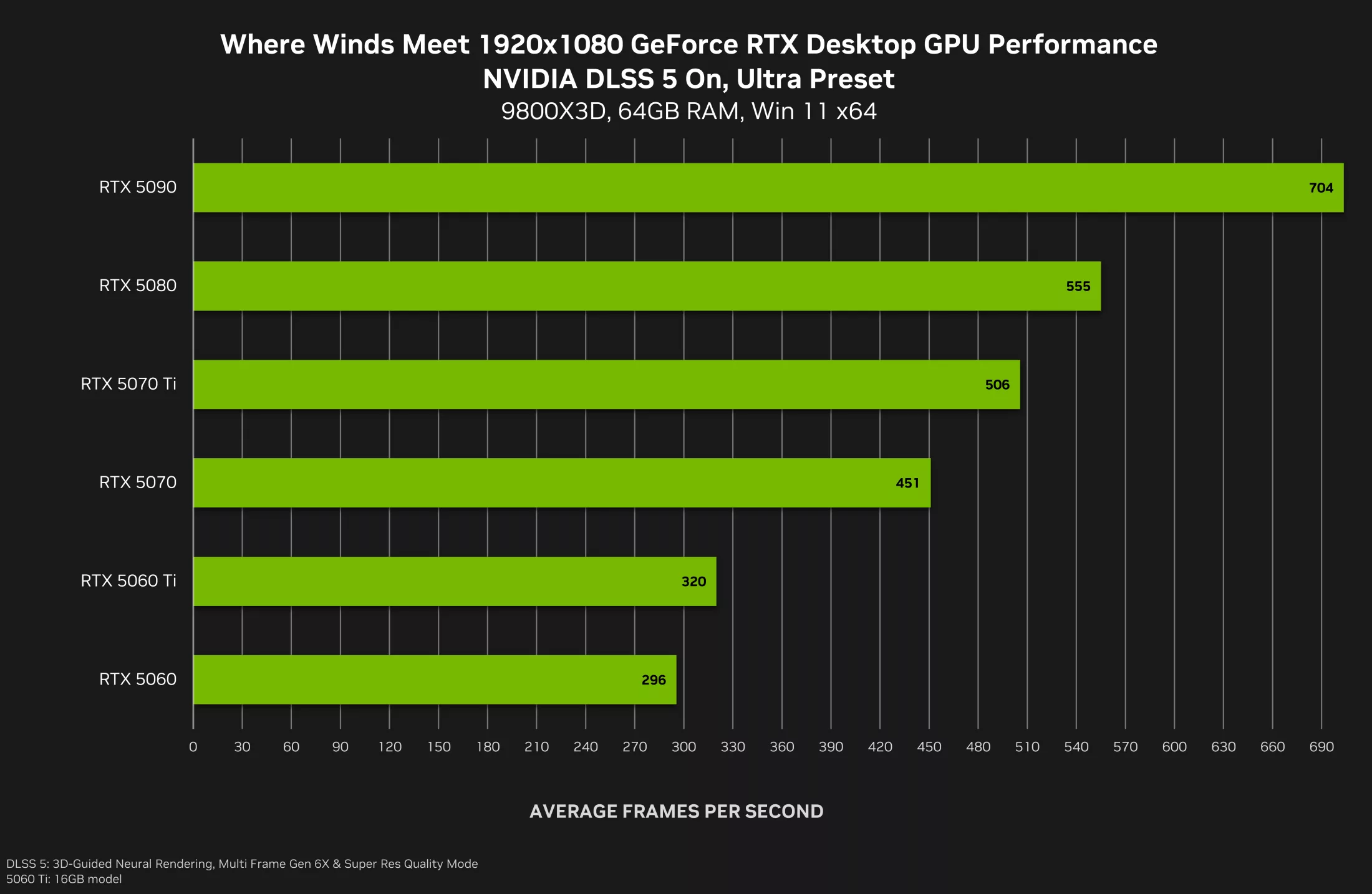
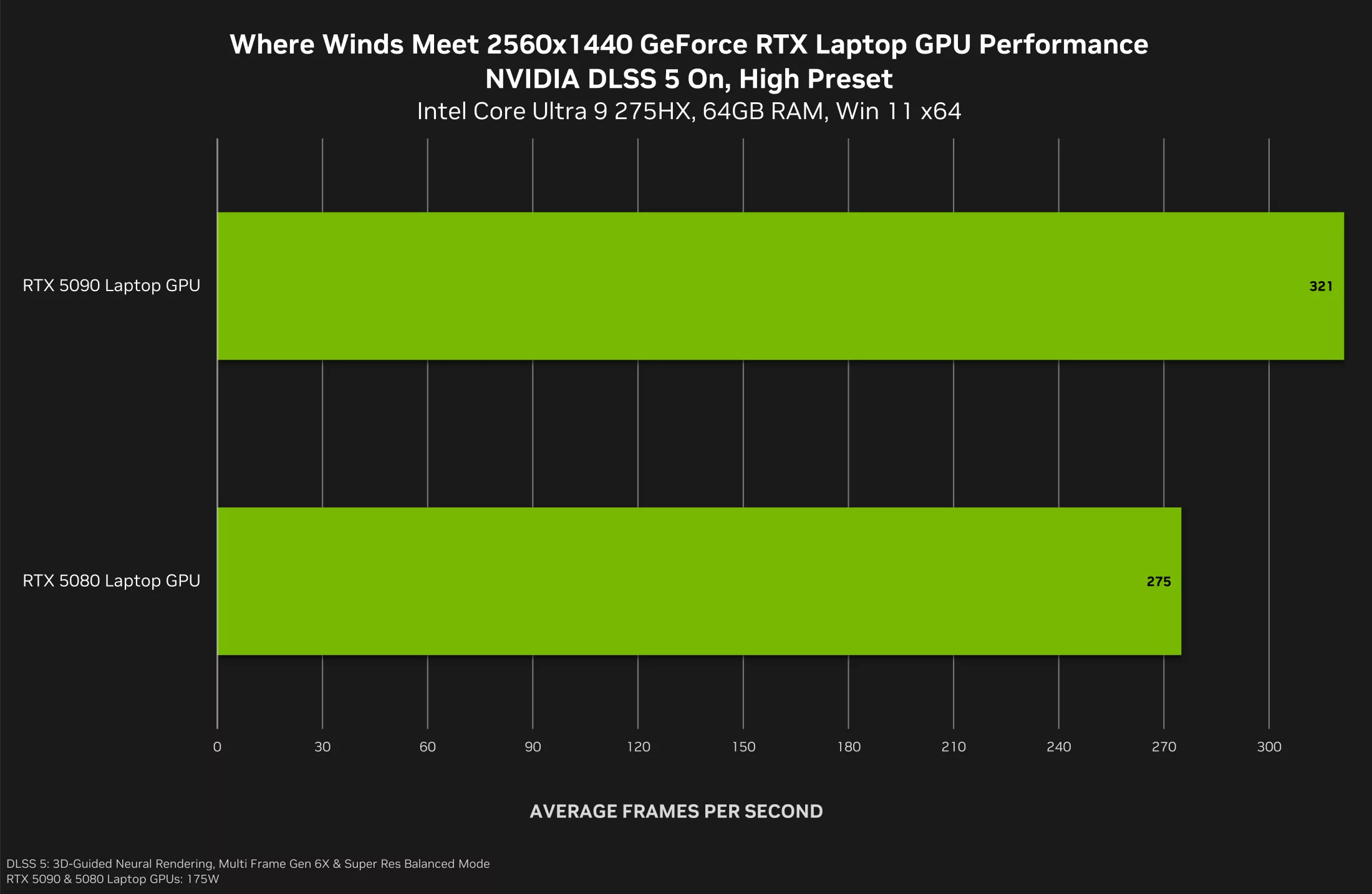
The implementation of DLSS 5, combined with Super Resolution and Multi Frame Generation, allows for significantly high frame rates at various resolutions. NVIDIA provided the following performance targets for Where Winds Meet at Ultra settings:
How 3D-Guided Neural Rendering Works
DLSS 5 represents an evolution of the technology from purely performance-oriented upscaling to visual fidelity enhancement. 3D-Guided Neural Rendering uses the game engine’s rendered frame—including artist-designed geometry, textures, and lighting buffers—as a foundation. The AI acts as the final rendering stage in the graphics pipeline, ensuring the engine's frame defines the core content while the neural rendering enhances the lighting and material details.
This approach is designed to be deterministic and temporally stable, as it takes the frame’s color and motion vectors as input. Crucially, NVIDIA emphasizes that this is a tool for developers; it provides art-direction controls that allow teams to decide how and where the AI-driven enhancements are applied, helping to manage compute and VRAM budgets while achieving photoreal detail that would be difficult to render explicitly.
Neural Rendering and Semantic Control
The core of the DLSS 5 implementation focuses on enhancing visual fidelity through neural rendering without altering the original artistic intent. In practical applications, such as the character models seen in Where Winds Meet, the technology targets specific lighting responses. This includes adding depth through ambient occlusion around accessories like headbands and simulating natural light transmission via enhanced subsurface scattering in skin. The goal is to elevate material detail and light response while keeping the underlying geometry and facial proportions exactly as designed by the artists.
To give developers granular control, the DLSS 5 SDK provides multiple neural models with different parameter weights. Developers can apply a single model to an entire game or mix and match them for specific scenarios—for instance, using one model for dense outdoor foliage and another for dramatic indoor lighting. This flexibility extends to gameplay versus cutscenes, allowing the technology to adapt to the specific artistic vision of a scene.
NVIDIA has introduced specific adjustment levers for developers: Structure Intensity and Tone Intensity. Structure Intensity allows for the enhancement of high-frequency details, such as reflections and ambient occlusion. Tone Intensity manages low-frequency details, including broader lighting and color response; setting this to zero allows for the exact colors from the rendered frame, while increasing it enables tonal adjustments based on the scene's requirements.
To prevent unwanted visual artifacts, DLSS 5 utilizes semantic AI masking. This allows the system to automatically recognize scene objects, enabling developers to boost environmental lighting while keeping characters untouched, or vice versa. Additionally, engine-level masking allows artists to isolate specific assets—such as glassware, water droplets, or foliage—to apply custom neural lighting tweaks to those elements without affecting the surrounding environment.
Evolution of the DLSS 5 Pipeline
NVIDIA reports significant progress in the DLSS 5 pipeline since its initial announcement in March. The technology has evolved from requiring dual GeForce RTX 5090s to running on a single graphics card, achieving what the company describes as a 10X performance gain over seven months. This optimization makes DLSS 5 available for all GeForce RTX 50 Series GPUs, RTX Spark devices, and via streaming for GeForce NOW Ultimate members.
The latest iteration, the October 2026 Neural Rendering model, is being implemented in titles like Hogwarts Legacy and Where Winds Meet. This specific model version has been optimized to reduce the computational footprint by 24%, bringing it down to approximately 118 million parameters. According to NVIDIA, this update reduces 4K VRAM usage by 20% and provides a 2X performance increase compared to the previous version of the technology.
Neural Rendering and Lighting Fidelity
The implementation of DLSS 5 in Where Winds Meet focuses on advancing visual realism through 3D Guided Neural Rendering. This technology aims to move beyond traditional rasterization and ray tracing limitations by using neural networks to interpret and reconstruct complex lighting environments. Instead of relying solely on standard geometric data, the neural engine assists in calculating how light interacts with surfaces, particularly in dense, atmospheric environments like those found in the game's open world.
In practical terms, this means the game can achieve more lifelike lighting effects—such as subtle light bounces and complex shadows—without the massive computational overhead typically required by full path tracing. The neural rendering process works alongside DLSS to upscale frames while simultaneously refining the lighting information, ensuring that the reconstructed image maintains high temporal stability and reduces artifacts that often occur during rapid camera movements in high-fidelity scenes.
Technical Synergy in Open-World Environments
The synergy between DLSS 5 and the game's rendering pipeline is most evident in the way it handles environmental complexity. Where Winds Meet features intricate landscapes and detailed foliage, which are notoriously difficult for traditional lighting models to render efficiently. By utilizing 3D Guided Neural Rendering, the system can intelligently fill in lighting details that would otherwise require significantly more hardware resources, effectively bridging the gap between real-time performance and cinematic visual quality.
- Enhanced light interaction through neural-assisted reconstruction.
- Improved temporal stability in complex, high-detail environments.
- Reduction in computational cost for advanced lighting effects compared to standard ray tracing.