

A Long Road Ahead for Zeus GPU: Bolt Graphics Successfully Boots Test Chip
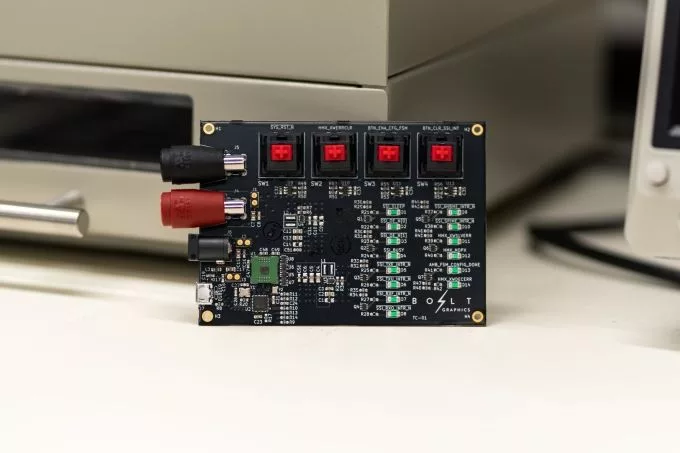
US-based startup Bolt Graphics has reached a significant milestone in the development of its Zeus architecture. The company has successfully completed the "bring-up" process for its first test chip, manufactured using TSMC's 12nm process. While this confirms the fundamental functionality of the technology, the company still faces a lengthy journey before reaching full-scale production.
The A0-Silicon Milestone
The test chip, designated as A0-Silicon, is a compact 6 mm² die. Notably, it demonstrates a massive leap in power efficiency compared to the previous FPGA-based platform, which required 35 W; this silicon sample operates at just 1.4 W. The testing was conducted across a temperature range of -40 to 85 °C and reportedly proceeded without issues.
Looking ahead, Bolt Graphics intends to utilize TSMC's 5nm N5P process for mass production of the Zeus GPU. By opting for the established 5nm node, the company aims to bypass the intense competition for wafer capacity currently seen in the most advanced leading-edge processes.
Zeus Architecture: A Modular Approach
The Zeus architecture is fundamentally different from the traditional GPU designs used by NVIDIA or AMD. It is built on the open RISC-V instruction set and utilizes a modular chiplet design. Each chiplet consists of 32 Zeus clusters, each combining a RISC-V CPU core (up to 3 GHz), 32 FP64 vector computing units (supporting FP64, FP32, and FP16 via RVV 1.0), and dedicated accelerators for matrix operations and Path Tracing.
Key architectural features include:
- Scalability: Using the UCIe interface, up to four chiplets can be interconnected in a single GPU package, scaling the architecture to 128 CPU cores and 4,096 FP64 computing units.
- Memory Subsystem: The design combines LPDDR5X with expandable DDR5 memory, allowing for significantly larger capacities than standard consumer graphics cards.
- Standalone Capability: Integrated RISC-V cores allow the GPU to run Linux directly, reducing the necessity for a separate host processor.
Timeline and Availability
The roadmap for Zeus is ambitious. Developer access is expected to open in Q1 2027, with the first Zeus GPU units available to Early Access customers by late 2027. Full-scale production of PCIe accelerator cards and complete server systems is currently slated for 2028.
Гика
