Biostar EdgeComp MT-U325: Intel Panther Lake Industrial PC with 128 GB DDR5 and 90 TOPS AI Performance
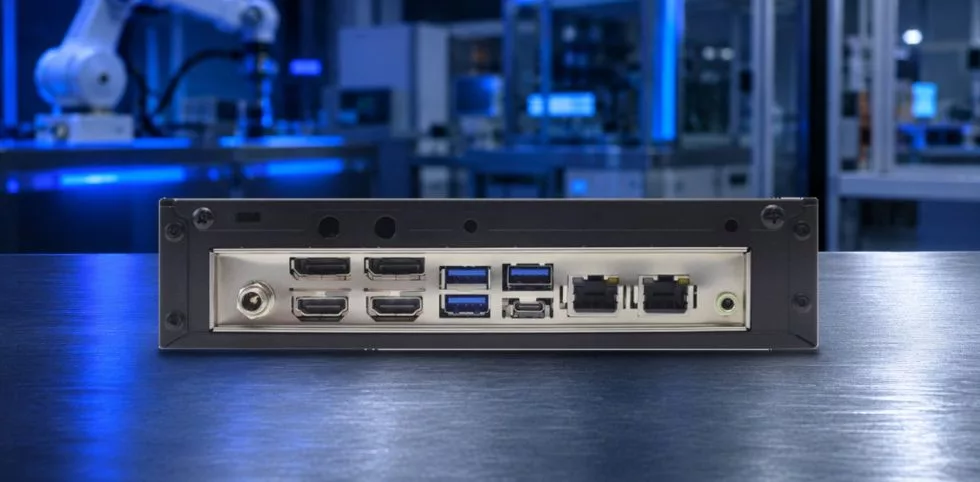
While consumer mini-PCs typically focus on integrated graphics performance, noise levels, and desktop replacement capabilities, Biostar is taking a different approach with the EdgeComp MT-U325. Announced on November 25, 2026, this industrial PC is built on Intel's Panther Lake architecture, pairing a Core Ultra 5 325 with up to 128 GB of RAM and four display outputs. Housed in a compact 1.7-liter chassis, the device boasts a combined AI performance of up to 90 TOPS—a figure that requires closer scrutiny regarding its composition and the practical limitations of such a small form factor.
At the heart of the system is the soldered Intel Core Ultra 5 325, part of the Core Ultra Series 3 family introduced in Q1 2026. This processor features eight cores: four Performance-cores and four highly efficient Low-Power Efficient-cores. Notably, this specific model lacks additional regular Efficient-cores, meaning the eight threads correspond directly to the eight physical cores. The CPU tile is manufactured using the Intel 18A process, while the integrated graphics rely on the Intel 3 process. The Performance-cores can reach a maximum turbo frequency of 4.5 GHz, while the Low-Power Efficient-cores top out at 3.4 GHz. Intel specifies a Processor Base Power of 25W and a Maximum Turbo Power of 55W.
It is important to note that the 25W base power should not be confused with the total power consumption of the entire system. How long the processor can maintain higher power limits depends heavily on the specific system configuration and its thermal solution. Biostar has not yet released detailed measurements regarding the system's behavior under sustained heavy loads.
Graphics and the Reality of '90 TOPS' AI Performance
The integrated Xe3 graphics unit features four Xe-cores and supports DirectX 12 Ultimate alongside hardware-accelerated ray tracing. While this level of graphics is entry-level for a gaming PC, the EdgeComp MT-U325 is designed for multi-monitor setups, video processing, and local computations. The GPU provides hardware acceleration for H.264, H.265, and AV1 encoding/decoding, and it supports H.266 (VVC) decoding.
The marketing claim of 90 TOPS requires clarification. A TOPS (Trillion Operations Per Second) represents a theoretical throughput for specific operations and data formats, but it does not directly translate to the speed of a real-world AI application. Intel specifies the Core Ultra 5 325 NPU at a maximum of 47 TOPS (INT8), with the integrated GPU contributing an additional 40 TOPS. Biostar reaches the 90 TOPS figure by aggregating the theoretical peak performance of the CPU, GPU, and NPU. However, these units cannot be simply added together for every application, as they differ in supported operations, memory access patterns, and software environments. An AI model must be specifically optimized for a particular unit to utilize its full potential.
For industrial applications that run continuously, the NPU is particularly valuable due to its high energy efficiency during long-running inference tasks. While the GPU offers more flexibility for certain models, the efficiency of the NPU is often more critical in industrial settings where power consumption and heat management are paramount.
Memory and Storage Capabilities
Biostar specifies a maximum capacity of 128 GB using DDR5 SO-DIMM modules with speeds up to 7,200 MT/s. This figure presents a discrepancy with Intel's official specifications for the Core Ultra 5 325, which lists support for up to 6,400 MT/s for standard DDR5 and 7,467 MT/s for LPDDR5X. It remains unclear whether Biostar's system actually operates at the full 7,200 MT/s rate or if the specification simply indicates supported module types. Nevertheless, the high capacity is a significant advantage for local AI workloads; since the integrated graphics lacks dedicated VRAM and shares system memory, a large pool of RAM allows for processing larger AI models than many discrete GPUs with limited VRAM could handle, even if the memory bandwidth is lower than GDDR or HBM solutions.
For storage, the device provides a PCIe 5.0 x4 M.2 slot alongside a PCIe 4.0 x2 M.2 slot, as well as a SATA III interface. This allows for a high-speed NVMe SSD for the operating system and a second drive for databases, video recordings, or large AI datasets.
Industrial Connectivity and Networking
What sets the EdgeComp MT-U325 apart from consumer mini-PCs is its combination of modern interfaces and six serial COM ports. While COM ports are rare on modern consumer motherboards, they remain essential in industrial environments for controlling legacy machinery, measuring devices, and POS systems. Additionally, the device features two independent 2.5 GbE Ethernet ports using Intel I226-LM and I226-V controllers. This physical separation allows for the isolation of a local machine network from a broader IT infrastructure, provided the user implements the necessary software and security configurations.
Remote Management and Connectivity
The remote management capabilities of the EdgeComp MT-U325 warrant a closer look. Biostar claims vPro support for remote management in conjunction with the I226-LM controller. However, while the Core Ultra 5 325 processor features Intel Standard Manageability, Intel's official specifications exclude full support for Intel Active Management Technology (AMT). Consequently, it remains unclear which specific remote management functions will be available in the final system.
For deployments outside of a stationary network infrastructure, the system offers optional 4G or 5G connectivity. The hardware design already includes a dedicated M.2 slot and a SIM card slot to facilitate this.
Power, Display, and Edge Computing
The power supply is designed for flexibility, accepting input voltages ranging from 9 to 24 V. With an operating temperature range of 0 to 50 °C, the system is intended for controlled industrial environments; it is not rated for extreme temperatures or unprotected outdoor installations. Regarding video output, Biostar states that the two HDMI 2.1 ports can drive resolutions up to 7,680 × 4,320 pixels at 60 Hz, while the two DisplayPort 1.4 ports support up to 4,096 × 2,160 pixels at 120 Hz. This allows for simultaneous control of up to four displays, though it is not specified whether all ports can reach their maximum resolution and refresh rate simultaneously.
The device is positioned for digital information systems, industrial interfaces, or surveillance applications, where the variety of outputs can reduce the need for additional hardware. Furthermore, the integrated AI compute units enable Edge Computing—the ability to process data locally at the source rather than transmitting all information to an external server. This approach can reduce network load and minimize latency, which is particularly beneficial for continuous streams of video and sensor data where only relevant events need to be reported to central systems.
Editorial Assessment
What stands out about the EdgeComp MT-U325 is its consistent focus on specific industrial requirements. Rather than simply slapping an 'AI' label on a standard mini-PC, Biostar combines current processor technology with interfaces that have largely disappeared from consumer desktop systems. The inclusion of six COM ports, dual Ethernet controllers, and flexible power input clearly defines its intended use cases.
However, the advertised 90 TOPS should be viewed with caution. Real-world AI performance depends heavily on the specific model used and its software optimization. There are also lingering questions regarding the actual DDR5 data rates and the full extent of the remote management features. Ultimately, metrics such as sustained power consumption under load, thermal management, and the yet-to-be-announced price will be more critical than theoretical peak AI performance.
Biostar has unveiled the EdgeComp MT-U325, a compact industrial PC designed around Intel's upcoming Panther Lake architecture. This machine is specifically engineered for industrial environments that require high-density memory and significant AI processing capabilities, moving beyond standard consumer-grade specifications into the realm of specialized edge computing.
Memory Capacity and DDR5 Support
One of the most notable technical aspects of the MT-U325 is its memory subsystem. The device supports up to 128 GB of DDR5 RAM. For industrial applications involving large datasets or complex simulations at the edge, this capacity provides a substantial buffer compared to typical embedded or small-form-factor systems. The integration of DDR5 ensures high bandwidth, which is critical for the data-intensive tasks this hardware is intended to handle.
AI Performance and TOPS
The MT-U325 is positioned to meet the growing demand for on-device AI processing. According to Biostar, the system delivers up to 90 TOPS (Tera Operations Per Second). This metric highlights the machine's ability to execute artificial intelligence and machine learning workloads locally, reducing the need for constant cloud connectivity and lowering latency for real-time decision-making in industrial automation.
Form Factor and Target Use Cases
Despite its high-performance capabilities, the MT-U325 maintains a compact industrial form factor. This design choice targets sectors where space is at a premium but computational power cannot be sacrificed—such as smart manufacturing, automated logistics, and advanced surveillance systems. By combining Panther Lake's efficiency with high-capacity DDR5 and dedicated AI throughput, Biostar aims to bridge the gap between standard industrial controllers and high-end workstations.