
Budget gaming laptop with RTX 5050: Asus TUF Gaming 16 review
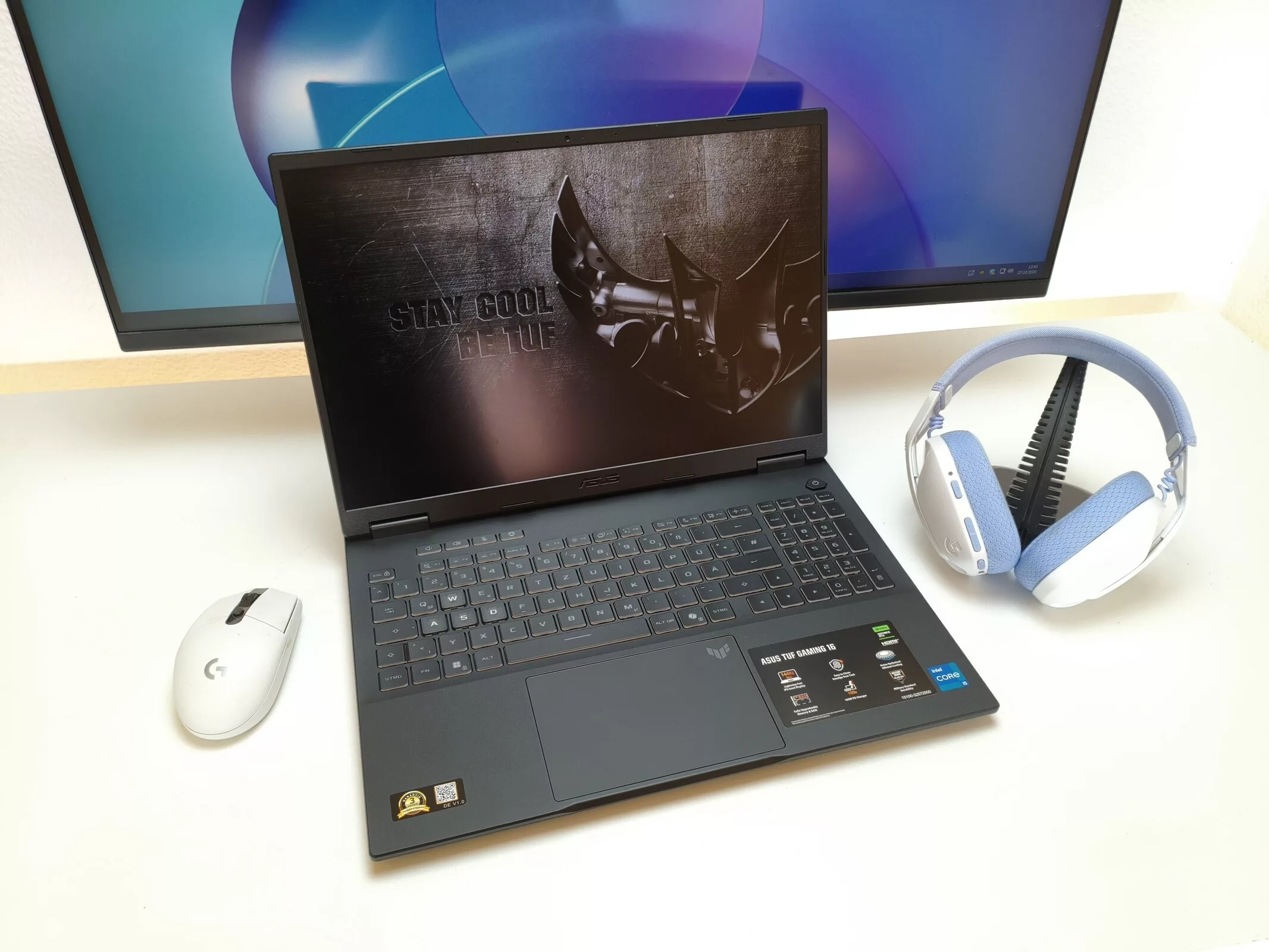
Finding a suitable gaming laptop is particularly difficult right now for anyone on a tight budget. The Asus TUF Gaming 16 aims to fill this gap, offering one of the more affordable entry points into modern gaming. While it doesn't break any records, it delivers a well-rounded package that balances performance with practical features like upgradeability and a decent display.
The Asus TUF Gaming 16 (specifically the FX610J suffix in our review unit) is designed as an accessible gateway to mobile gaming. Under the hood, it is powered by an Intel Core i5-14450HX from the Raptor Lake generation. For graphics, it utilizes the Nvidia GeForce RTX 5050 with 8 GB of GDDR7 VRAM, a chip that sits in the lower midrange of the current dedicated GPU landscape. Our test unit also comes equipped with 16 GB of DDR5 RAM and a 512 GB NVMe SSD, all running on a 144 Hz IPS panel.
Build, Connectivity, and Input Devices
The chassis is constructed from dark plastic, weighing approximately 2.2 kg. While it doesn't feel premium, the build quality is adequate and offers sufficient rigidity for daily use. One standout feature is the 180° opening angle of the lid, which is a welcome addition for ergonomics. Internally, the device is quite user-friendly; accessing the components requires removing several Phillips screws, after which the RAM and M.2 slots are easily accessible.
Regarding connectivity, the port selection is functional for its price range, though it is not without omissions. The laptop lacks a card reader and Thunderbolt support, and the USB connectivity options are not as modern as some higher-end competitors. The input devices are reliable: the touchpad measures roughly 13 x 8.5 cm, and the keyboard features RGB backlighting along with dedicated keys for volume and other essential functions.
Display Performance
While many budget laptops compromise on screen quality, the TUF Gaming 16 performs surprisingly well in the color department. It covers 100% of the sRGB color space, a feat that many of its direct competitors fail to achieve. The 16-inch IPS panel features a 1920 x 1200 resolution (16:10 aspect ratio) and a 144 Hz refresh rate, which is well-matched to the performance level of the RTX 5050. We measured an average brightness of 306 cd/m² and a contrast ratio of 1,377:1, which is typical for this panel technology.
The display also shows an advantage in response times compared to several rivals in the same segment. However, users should note the glossy finish, which may lead to reflections in brightly lit environments.
Display: Fast and Accurate, but Lacks Color Depth
The 16-inch IPS panel (NE160WU1-MY2) in the Asus TUF Gaming 16 is a standout feature for a budget-oriented machine, particularly regarding motion clarity. Our tests showed very fast response times—7.9 ms (Grey 50% to 80%) and 7.6 ms (Black to White)—making it well-suited for fast-paced gaming where ghosting is a concern. In fact, its response rates are better than 22% of all tested devices in its class.
While the motion is fluid, the color reproduction is geared toward standard sRGB usage rather than professional creative work. The screen covers 100% of the sRGB gamut and 76.2% of AdobeRGB, but only 76.1% of the Display P3 space. This makes it excellent for general gaming and web content, but less ideal for color-critical tasks. Brightness levels are respectable, peaking at 328 cd/m² (average 305.9 cd/m²), which is sufficient for most indoor environments.
Notably, the display does not use Pulse-Width Modulation (PWM) for dimming, meaning flickering was not detected during our testing—a significant plus for users sensitive to screen flicker.
Performance: Solid Mid-Range Power
Under the hood, the Intel Core i5-14450HX provides reliable multi-core performance. In Cinebench R15, it achieved an average of 2021 points, placing it roughly on par with the AMD Ryzen 5 240. While it is outperformed by higher-tier chips like the Ryzen 7 260 or the Intel Core 7 250H, it remains a capable engine for modern gaming, especially when paired with the RTX 5050.
In real-world gaming scenarios, such as Cyberpunk 2077 at FHD/Ultra settings, the laptop delivered 68.9 fps in Performance mode. To reach higher frame rates, users can engage Turbo mode, which pushes the GPU power draw to ~80 W and the CPU PL1 to 85 W, resulting in 73.8 fps, though this comes with increased noise levels (46 dB(A)).
System Responsiveness and Storage
In terms of overall system performance (PCMark 10), the Asus TUF Gaming 16 scored 7292 points. This places it ahead of other RTX 5050-equipped laptops like the Acer Nitro V 16 or the MSI Cyborg 15, though it still trails behind machines equipped with the more powerful RTX 5060. The included Kioxia SSD performs adequately, landing it in the middle of the pack during our comparative testing.
GPU and Gaming Performance
The RTX 5050 in this laptop is the smaller sibling to the RTX 5060. While it shares the same 8 GB of GDDR7 VRAM, it features a significantly reduced core count, with shader units dropped from 3,328 to 2,560. In our 3DMark testing, the TUF Gaming 16 delivered an unremarkable showing, performing in line with the average results we have measured so far for the RTX 5050 mobile class.
In actual gaming, the results are similar. If you maintain high detail settings and disable ray tracing, most titles run smoothly at Full HD even without the assistance of DLSS or other upscaling features. However, the 8 GB of VRAM will likely become a limiting factor for high-end gaming in the long term.
Benchmark Results
- 3DMark Time Spy Score: 8,648
- 3DMark Fire Strike Score: 21,010
- 3DMark Cloud Gate Score: 54,116
- 3DMark 11 Performance: 25,795
- 3DMark 06 Standard Score: 50,645
When looking at heavy workloads like Blender, the TUF Gaming 16 (using the i5-14450HX) clocked in at 27 seconds for the Classroom OPTIX/RTX test. This is slightly faster than the average RTX 5050 laptop (31.6 seconds) but falls behind the more powerful RTX 5060-equipped Lenovo Legion 5 15AHP G10, which completed the task in 21 seconds.
Real-World Gaming Benchmarks
In modern titles, the performance is consistent with its class. In Cyberpunk 2077 at Ultra settings, the device averaged 61.6 fps. For comparison, the RTX 5060-based Lenovo Legion 5 15AHP G10 achieved 82.5 fps in the same scenario. In Baldur's Gate 3, the TUF Gaming 16 maintained a solid 74.4 fps on high settings.
Acoustics and Thermals
The Asus TUF Gaming 16 is generally quiet during idle periods, though the fans do occasionally ramp up. Under load in Performance mode, we measured noise levels between 41 and 46 dB(A), which is quieter than many of its competitors. For instance, the HP Victus 15 reached 50 dB(A) under similar conditions.
Thermal management is also efficient. During our stress tests using FurMark and Prime95, the chassis reached a maximum surface temperature of 44 °C on the top and 42 °C on the bottom. Internal temperatures for both the CPU and GPU remained moderate, settling at just under 70 °C during the stress test.
Thermal Management and Surface Temperatures
The Asus TUF Gaming 16 FX610J demonstrates efficient thermal management compared to many of its competitors in the gaming class. Under maximal load, the upper side reaches an average temperature of 34.3 °C, which is slightly lower than the gaming class average of 33.9 °C. The maximum temperature recorded on the upper side was 44 °C, staying well below the class average of 40.4 °C. The bottom of the chassis heats up to a maximum of 42 °C, which is actually cooler than the class average of 43.2 °C.
Crucially for user comfort, the palmrest and touchpad areas remain cool to the touch, with a maximum temperature of 25 °C. This is significantly better than the class average for palmrest areas, which typically reaches 28.8 °C.
Audio Quality and Speaker Performance
The speaker quality is described as decent, performing on par with the Acer Nitro V 16 AI and Lenovo Legion 5. The loudness is average but good, peaking at 80 dB. In terms of frequency response, the audio profile shows a reduction in bass, measuring 8.8% lower than the median. However, the mids are linear, and the highs are well-balanced, with the high-frequency response staying within 2.8% of the median.
When compared to the broader gaming class, the audio performance of the TUF Gaming 16 is outperformed by 38% of devices, while 55% of tested devices in this category perform worse.
Power Consumption and Battery Life
Power consumption for the device remains within the expected range for its performance class, ranging from approximately 8W at idle to 150W under heavy load. In a Wi-Fi test, the integrated 63 Wh battery lasted nearly 6.5 hours—a result that is considered neither exceptionally high nor low for this segment.
- Idle Power: 7.9 W (min) to 14.5 W (max)
- Load Power: 71 W to 150 W
- Battery Capacity: 63 Wh
The Asus TUF Gaming 16 FX610J positions itself as a reliable budget gaming laptop. While it manages to get most aspects of the user experience right, making it a safe choice for many, it faces stiff competition from machines equipped with the more powerful RTX 5060, which are sometimes available at a comparable price point.
Performance and Hardware Configuration
The tested configuration features an Intel Core i5-14450HX paired with an NVIDIA GeForce RTX 5050 Laptop GPU. It is equipped with 16 GB of memory and a 512 GB SSD. In terms of display, the device utilizes a 16.00-inch IPS panel with a resolution of 1920x1200 (142 PPI).
Verdict and Comparison
The overall rating for the Asus TUF Gaming 16 is 78%. While it excels in thermal management (96%) and power efficiency (94%), it shows weaknesses in connectivity (61%) and camera quality (44%). When compared to other budget options, the device sits in a competitive landscape:
Гика
