Apex Neural Rendering: New AI Tech Aims to Challenge DLSS and FSR
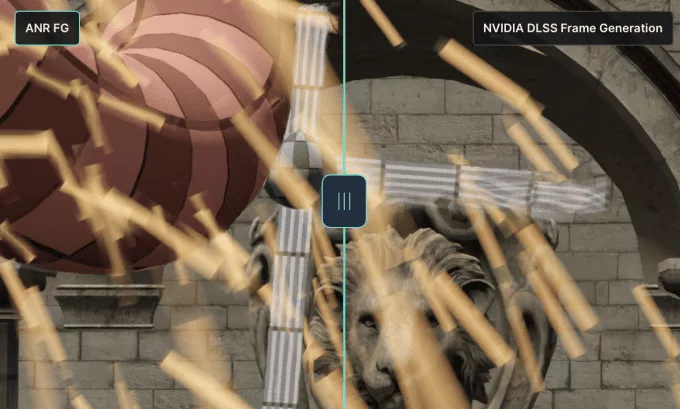
A new player has entered the AI upscaling and frame generation arena. Apex Compute has unveiled Apex Neural Rendering (ANR), a technology designed to compete directly with industry standards like NVIDIA's DLSS, AMD's FSR, and Intel's XeSS. While established solutions often require specific hardware or the latest architectures to access advanced features like Frame Generation, ANR aims for broad compatibility, potentially bringing AI-driven enhancements to older GPUs that have been left behind by the current generation of upscaling technologies.
Apex Neural Rendering is positioned as a comprehensive suite of three core functions: Super Resolution for image upscaling, Frame Generation to increase frame rates by creating intermediate frames, and Ray Reconstruction to improve visual quality in ray-traced scenes. Unlike many current implementations that are tightly coupled to specific proprietary hardware, ANR is designed to be largely vendor-agnostic. While the Super Resolution and Ray Reconstruction components are still under development, a beta version of the Frame Generation feature is already available for testing.
Broad Hardware Support and Technical Approach
Technically, the Frame Generation component of ANR relies on a highly compact neural network. According to Apex Compute, the model weights occupy only 0.17 MB. The network is designed to work across different GPU architectures; while it can leverage dedicated AI accelerators—such as Intel's XMX units in the Arc B-series or the matrix functions in newer Radeon GPUs—it is also capable of running on hardware without specialized AI cores. Currently, integration into games is achieved via OptiScaler, which utilizes existing frame generation interfaces.
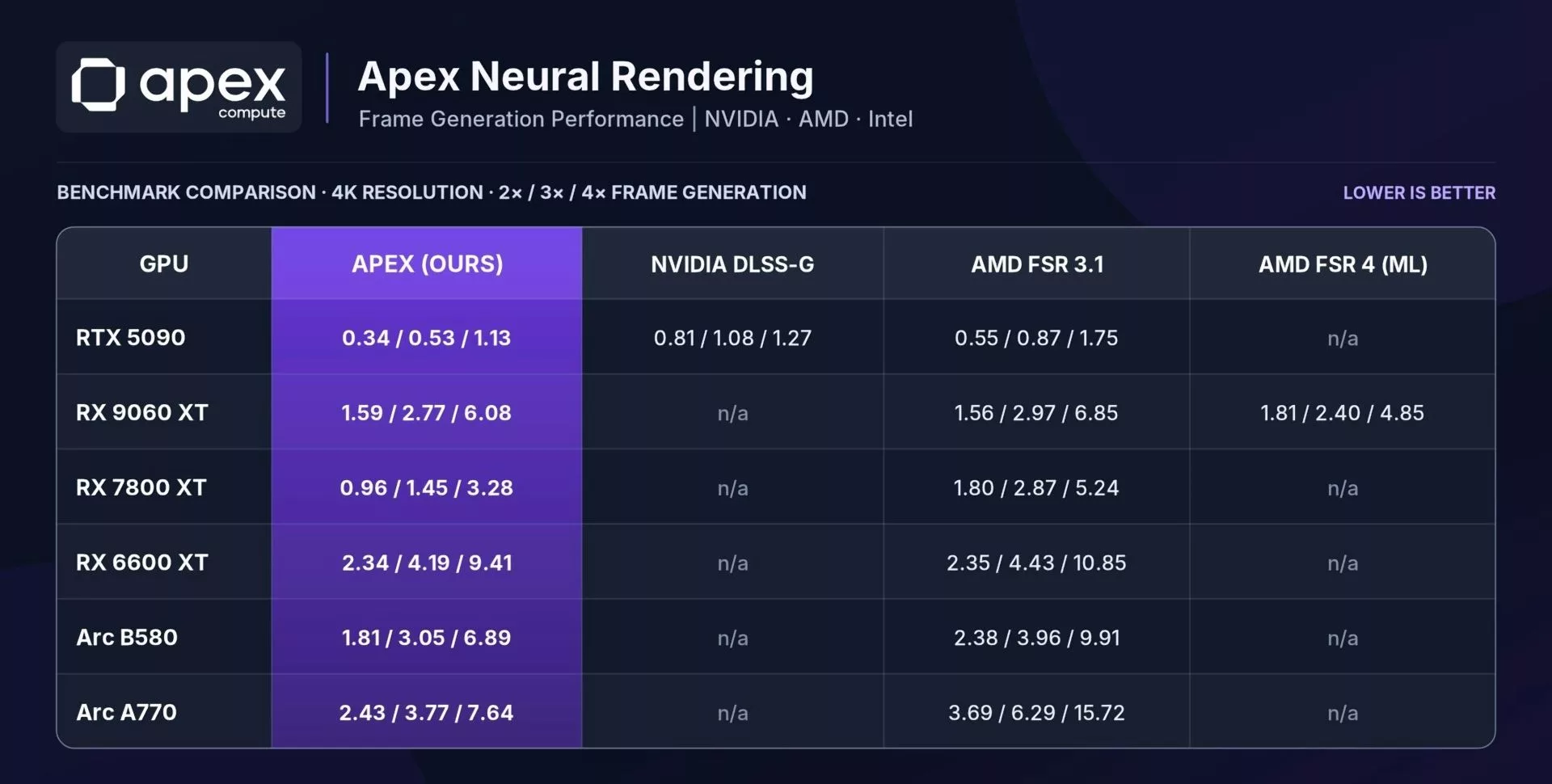
This approach offers a significant advantage in terms of accessibility. While NVIDIA's Frame Generation requires at least an RTX 40-series card, and their upcoming Multi Frame Generation is reserved for the RTX 50-series, ANR supports a much wider range of hardware. This includes NVIDIA GeForce GTX 16 and RTX 20/30/40/50 series, AMD Radeon RX 5000 series and newer, Intel Arc A/B series, Steam Deck, and Apple M1 or newer chips. This could make ANR particularly relevant for users with older hardware who currently lack access to AI-based frame generation.
Performance Claims and Efficiency
Apex Compute is also making bold claims regarding efficiency and performance overhead. In a comparison conducted on a GeForce RTX 5090 at 3840 × 2160 resolution, the company reports that ANR in 2x mode requires 1.01 ms per generated frame, compared to 1.26 ms for DLSS Frame Generation. In 4x mode, the reported average is 0.61 ms versus 0.82 ms for DLSS. Furthermore, Apex Compute claims a significantly lower VRAM footprint, stating that ANR requires 214 MB of additional video memory, whereas DLSS requires 562 MB. However, it is important to note that these are manufacturer-provided figures, and independent verification of these performance and quality metrics is still pending.
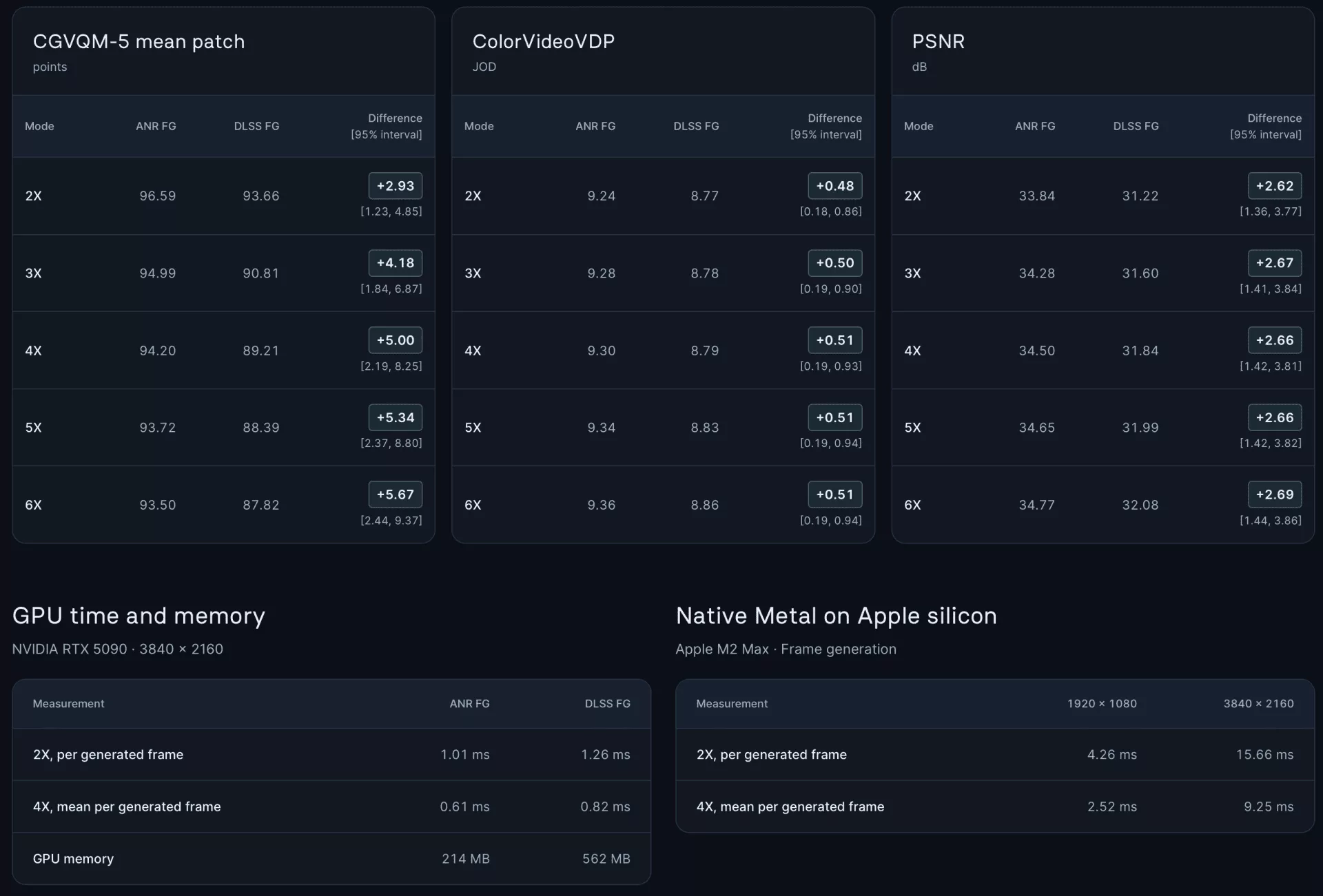
While the company promises advantages in reconstructing moving objects and fine details, several questions remain. Since the underlying neural network architecture has not been fully disclosed and the technology is still in its beta phase, the actual impact on image quality, game compatibility, and input latency remains to be seen.