
AMD brings official Ryzen overclocking to Linux
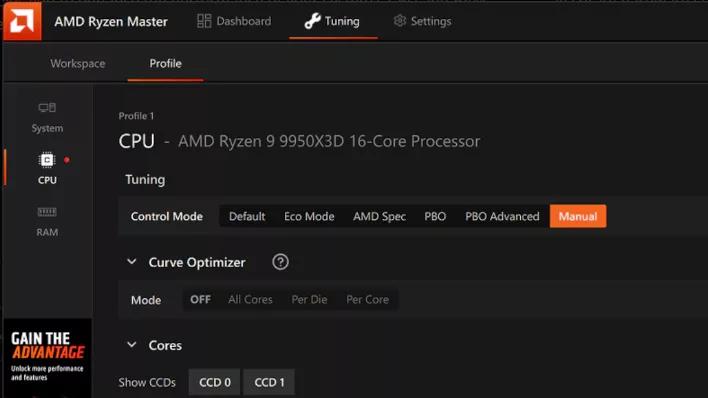
AMD is taking steps toward feature parity between Windows and Linux. According to notes sent to the AMD Linux platform driver mailing list, the company has officially ported the AMD Overclocking Driver (AOD)—the core component used by the AMD Ryzen Master software—to Linux. While this is not yet a complete feature-for-feature port of the Windows utility, it provides a critical foundation for CPU control in the Linux ecosystem.
Initial feature set is limited
The initial release of the AOD Linux driver is intentionally restricted in scope. As stated by AMD's Shyam Sundar S K, the current version focuses on a specific subset of functions:
- Simultaneous Multi-Threading (SMT) enable/disable switch;
- Read-only memory clock access;
- Adjustments for PPT, TDC, and EDC limits, including their supported ranges and step sizes.
There are important technical nuances regarding how these settings are applied. Changes to PBO PPT limits are stored in firmware and take effect only after a reboot; furthermore, these attributes are currently write-only, meaning the system does not report the active PPT, TDC, or EDC limits. In contrast, HSMP (Host System Management Interface) changes affect the runtime limits in the SMU immediately, but these settings are lost upon reboot.
A modular approach to Linux software
Rather than simply porting the full Ryzen Master utility, AMD is opting for a modular approach. By releasing the AOD driver, the company is enabling Linux developers to integrate Ryzen CPU controls directly into their own software, moving beyond existing HSMP support. This modularity allows for a variety of tools to emerge, ranging from simple controllers to highly granular management suites.
To support this, new directories such as drivers/platform/x86/amd/wmi/ are being added to the kernel to collect AMD WMI drivers over time. While real-time tuning—a staple of the Windows Ryzen Master experience—is currently unavailable, the roadmap suggests a gradual expansion of features aimed at achieving full parity with the Windows environment.
Гика
