

AI Programmer Runs DOOM on Custom CPU Designed by GPT-5.6 Sol
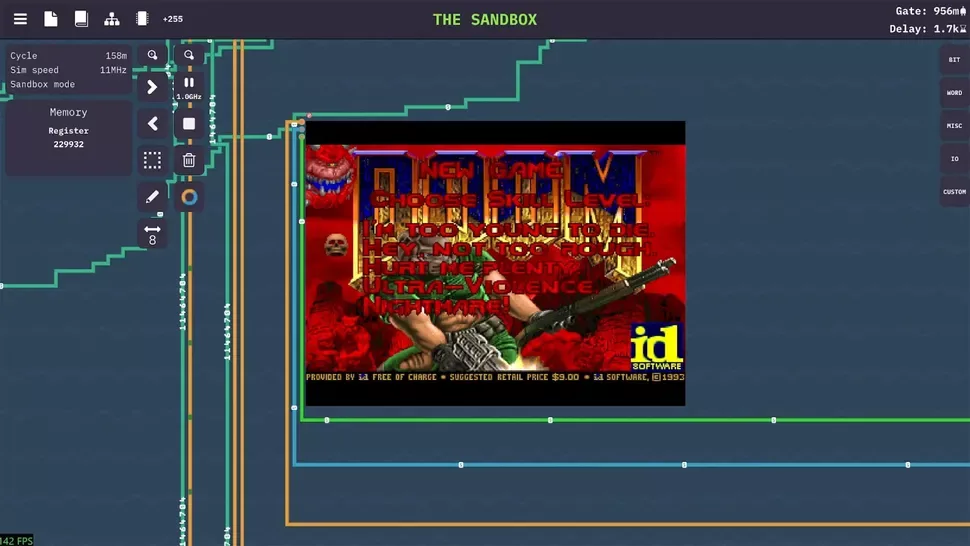
An AI computing enthusiast named Angel (@Angaisb_) has demonstrated the execution of DOOM on a custom CPU designed by GPT-5.6 Sol. The demonstration, shared via a tweet from August 23, 2026, features the classic 1993 game running within a visualized sandbox environment where the processor's circuitry is animated in real-time.
The custom processor, named Codex-R32, was constructed using basic components to build a virtual computer system. Angel chose DOOM specifically because it serves as a popular benchmark for computing performance despite its age. By running the game on this bespoke hardware, the project visually proves that Large Language Models (LLMs) can not only write software but also recreate functional hardware architectures capable of executing complex tasks.
The simulation takes place within Turing Complete's sandbox mode, an educational environment for computer science. In the video, viewers can observe live circuit diagrams of the processor's gates, registers, memory, Arithmetic Logic Units (ALUs), and other blocks. Real-time statistics are displayed alongside the animation, including cycle counters, simulation speed, and current memory or register values.
Technically, the Codex-R32 CPU is built from primitive logic components within a Turing Complete framework. The game itself utilizes a C-based PureDOOM port, which was compiled into native RV32IM machine code to run directly on the custom architecture. This setup highlights the versatility of AI agents in bridging the gap between high-level design and low-level hardware implementation.
The demonstration has sparked further discussion about future challenges. While DOOM is relatively small in scale compared to modern titles, Angel noted that the community's next logical step would be attempting to run Crysis. When prompted by this ambitious follow-up goal, the AI agent responded with a plan to build a GPU and add several gigabytes of RAM, suggesting that the path toward running graphically intensive games on AI-designed hardware is already being mapped out.
This project stands as a significant proof-of-concept for agentic coding. It moves beyond theoretical capabilities to show a tangible result: an AI model successfully designing a processor and verifying its functionality by running a demanding legacy application. The visual overlay of the game on the moving circuit board provides a unique perspective on how software interacts with custom-built hardware, offering both technical insight and visual entertainment.
Гика
